A chimney inspection report can read like a long list of problems, and not all of them deserve the same urgency. Some defects let water into the brick and the attic every time it rains; in Kirkland that means they grow every week from October to May. Others are cosmetic, or slow enough to schedule next summer. This guide sorts common chimney defects by how fast they get worse under Northshore weather, explains the roof-level culprits that cause most leaks, flags the case where cracking masonry is a symptom of ground movement rather than a chimney problem, and ends with how each type of repair is priced on our grid.
Water is the clock
In WeatherSpark's model, November is Kirkland's wettest month with roughly 8.2 inches, and the cool season runs from mid-November to the start of March, with the snowiest weeks falling between mid-December and late January. For the Puget Sound lowlands, the Western Regional Climate Center gives an average January minimum of 28 to 32°F. That combination, saturated brick sitting close to freezing, is what turns a hairline crack into a spalled face and a loose brick over a couple of winters.
So the first sorting question for any defect is simple: does it let water in? If it does, it goes to the top of the list, and ideally it gets fixed before October.
A quick triage table
Use this to rank the items on an inspection report. The timing column assumes the chimney is in regular use.
| What the report finds | Usually caused by | How soon to act |
|---|---|---|
| Gaps or lifted edges in flashing | Sealant aging out, shingles replaced without new flashing | Before the wet season; it feeds leaks into the attic |
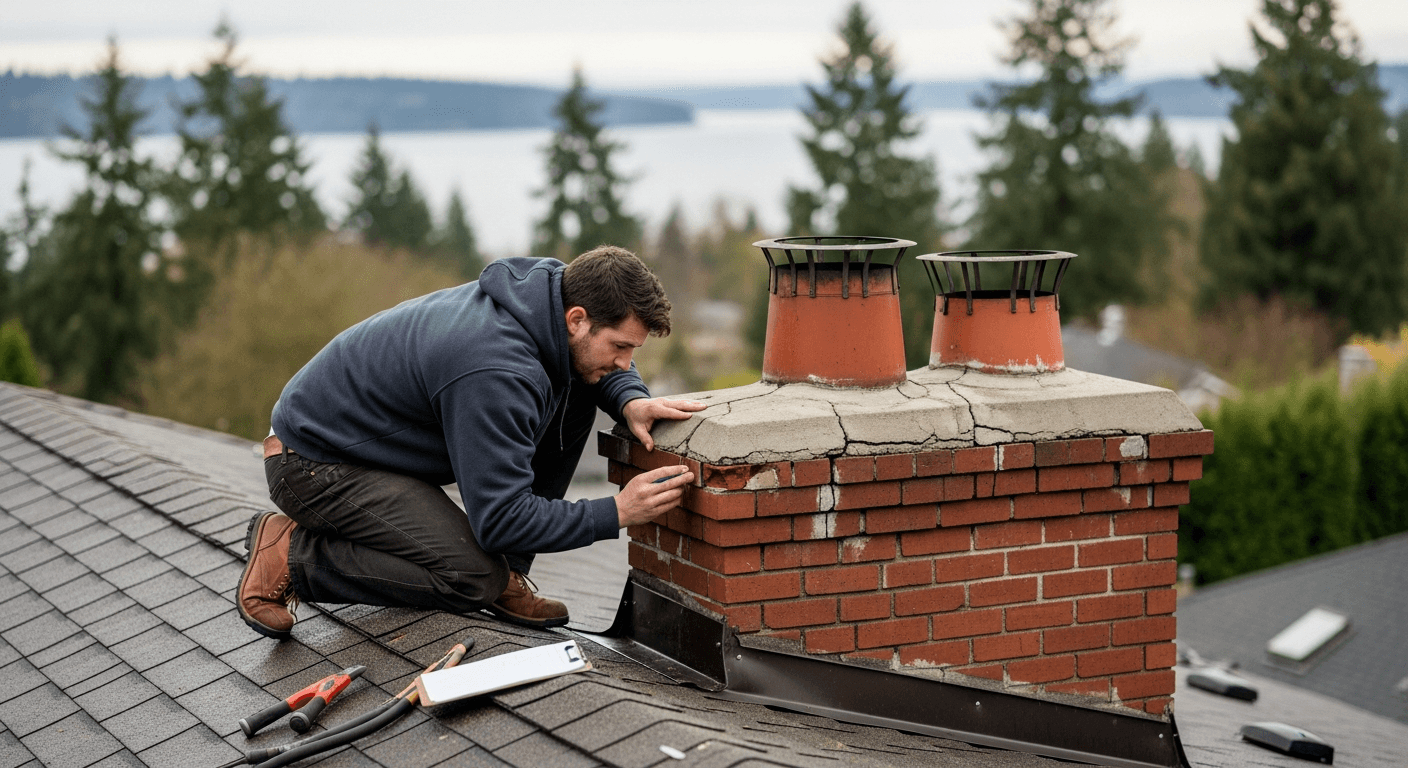
| Cracked or broken crown | Freeze and thaw, a crown poured too thin | Before the wet season |
| Missing or torn cap | Wind, rust, a cap never installed | Soon; rain and animals get straight into the flue |
| Eroded mortar joints | Decades of wetting and drying | Within the year, before bricks loosen |
| Spalled brick faces on a few courses | Water absorbed and frozen in the brick | Plan for dry weather; waterproof after repair |
| Efflorescence (white salt stains) | Water moving through the masonry | Find the entry point; the stain itself is cosmetic |
Roof-level culprits: flashing, crown and moss
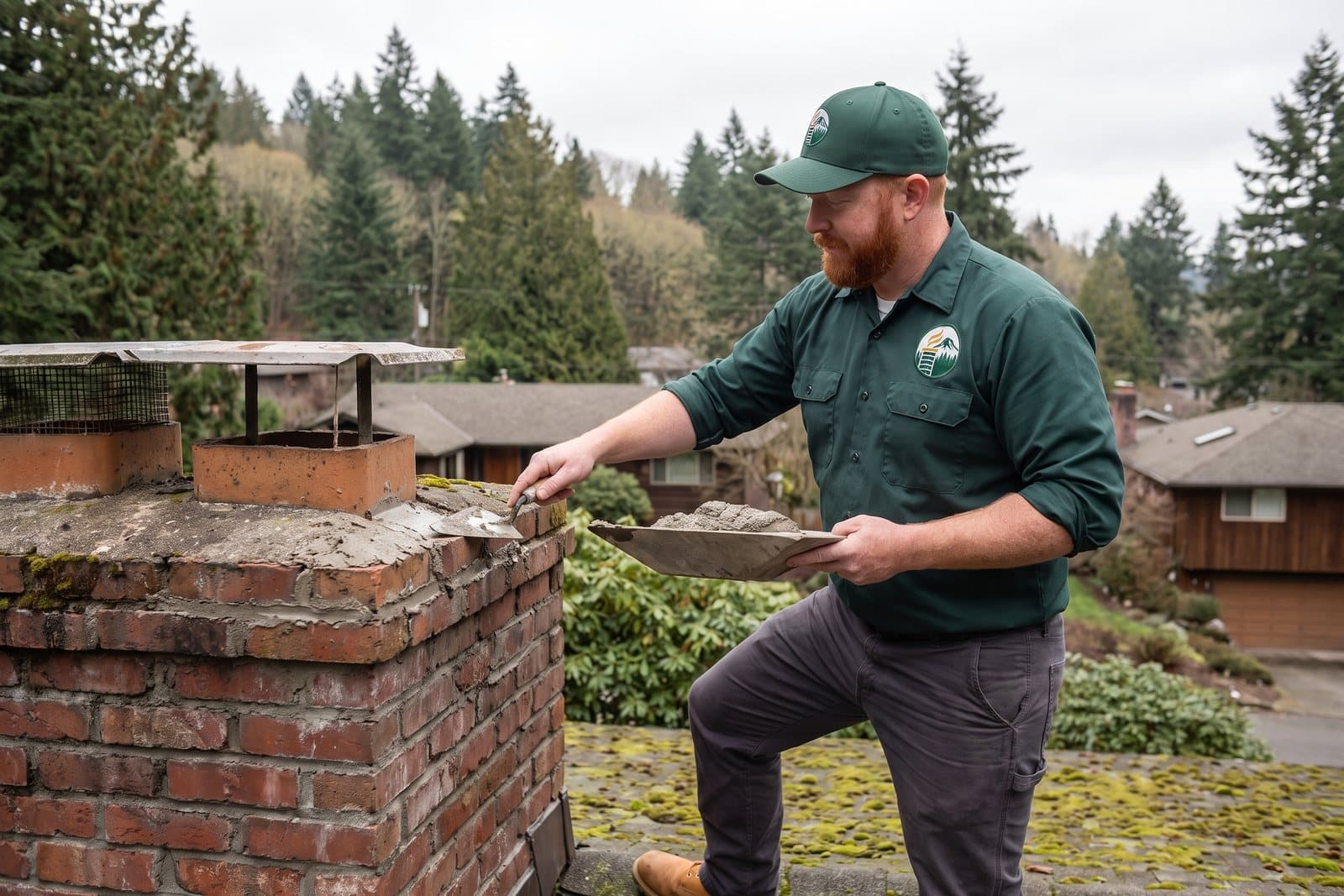
Most chimney leaks start where the stack meets the roof. Flashing that has pulled away, or was never counter-flashed into the mortar joints, lets water run down the outside of the masonry and into the framing. Washington's 2021 residential code adds a rule for broad stacks: a stack broader than 30 inches along the line of the ridge, standing downslope of the peak, must get a cricket, a small peaked diverter, on its uphill face. Without one, water and debris pond against the back of the masonry.
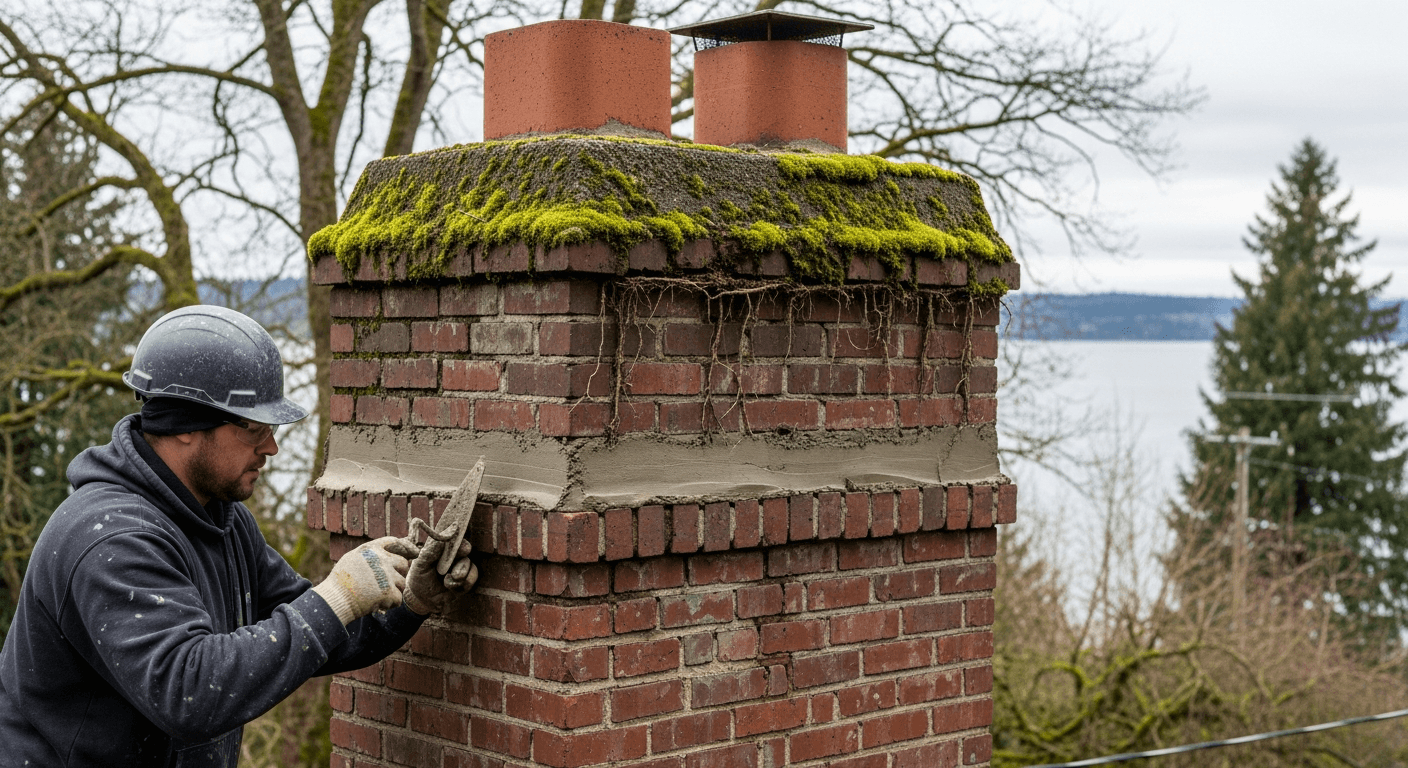
Moss makes all of it worse. Oregon State University Extension describes moss as nearly unavoidable on shaded Pacific Northwest roofs, and notes that it traps soil and debris, holds moisture and can lift shingles so water gets underneath. The lasting fix it recommends is more sunlight, usually by trimming overhanging branches, rather than repeated scraping.
When a cracked chimney is not a chimney problem
Some cracks come from below. On its landslide hazard page, Kirkland's emergency management office treats fresh cracking in plaster, tile, brick or a foundation as a possible sign of moving ground, especially when interior doors or windows begin to bind. As the Kirkland Reporter described in 2014, county and city hazard maps take in the steep west slopes of Finn Hill, around Big Finn Hill Park and O.O. Denny Park, along with many houses in the Holmes Point area.
When a chimney splits during the same months the rest of the house begins to shift, repointing the brick only treats the symptom. Get the ground looked at first.
How each repair is priced
Our grid prices flashing work at $375 to $1,500, the top end being full replacement. Crown and repointing jobs run $475 to $3,200 depending on how much surface is involved. Broader chimney repairs sit between $425 and $3,700, scaled to how much brick and mortar is involved. A new stainless cap is $235 to $850, and a breathable water repellent, applied once repairs are complete, is $285 to $795.
An inspection comes first, at a flat $99 plus tax, and that fee is taken off the repair when you give us the go-ahead on the written quote.
Frequently asked questions
Which chimney repair should come first if I can only afford one?
Whatever is letting water in. Failed flashing, a split crown or a missing cap all feed rain into the masonry and the house, and every wet month makes the next repair larger. Cosmetic spalling on a lower course can usually wait.
Can I pressure-wash the moss off my roof around the chimney?
Oregon State University Extension warns that improper pressure-washing can damage shingles. It also cautions against zinc sulfate moss treatments on roofs with copper flashing or gutters, because zinc corrodes copper.
The cracks in my chimney appeared at the same time as sticking doors. Is that related?
Possibly. Kirkland's hazard guidance treats jamming doors and fresh cracks in masonry as possible signs of ground movement. If the two show up together, especially on a slope, talk to the city or a geotechnical engineer before repairing the chimney.
Sources
- WeatherSpark — Kirkland climate — accessed September 29, 2026
- Western Regional Climate Center — Climate of Washington — accessed September 29, 2026
- UpCodes — Washington Residential Code 2021, Chapter 10 — accessed September 29, 2026
- Oregon State University Extension — Controlling roof moss — accessed September 29, 2026
- City of Kirkland — Landslides (Know Your Hazards) — accessed September 29, 2026
- Kirkland Reporter — City assessing landslide-hazardous areas — accessed September 29, 2026
Related services