Yes — if you feel a cold draft near a closed fireplace, smell musty air from the firebox, or can't move the damper handle, your damper has likely failed and needs professional attention before another heating bill arrives. In Kirkland, where October-through-April rainfall averages over 30 inches and fireplaces in 1970s–1980s homes are now 40–50 years old, damper failures are among the most common — and most expensive to ignore — chimney problems we see. This guide shows you exactly how to identify the failure, what repair or replacement costs in Kirkland right now, and how to choose the right fix for your home.
What a chimney damper actually does — and why Kirkland's climate destroys them faster
Your damper is a metal plate or sealing cap positioned either just above the firebox opening (a throat damper) or at the very top of the flue (a top-mount damper). When the fireplace is not in use, a working damper closes the flue completely — blocking cold outdoor air from pouring into your living space and preventing your heated indoor air from escaping up the chimney.
Kirkland's climate is particularly brutal on throat dampers. The city receives roughly 37 inches of precipitation per year, most of it between October and April, and winter temperatures hover between 38°F and 44°F — cold enough to accelerate metal corrosion but warm enough that freeze-thaw cycles repeatedly stress cast-iron damper frames. Moisture migrating down an unsealed flue rusts the plate and warps the frame, often within 15–20 years in neighborhoods like Juanita, Bridle Trails, and Totem Lake, where a large share of homes were built between 1972 and 1988 and still have their original throat dampers.
Top-mount dampers — which seal at the chimney crown with a rubber gasket rather than inside the firebox — largely sidestep this problem because they keep rain and debris out of the flue entirely. They also serve as a chimney cap, eliminating the main entry point for the raccoons, starlings, and squirrels that regularly nest in Kirkland chimneys each spring. For wood-burning fireplaces in this part of the Eastside, upgrading from an aging throat damper to a top-mount unit is almost always the most cost-effective long-term decision.
Five specific signs your damper needs attention right now
1. A cold draft comes from the fireplace opening when it is not in use. This is the single most common call we receive from Kirkland homeowners in November and December. When a throat damper plate corrodes, bends, or loses its handle mechanism, it rests at an angle rather than closing flush against the frame — leaving a direct gap between your living room and the outside air above the roofline.
2. A persistent musty, smoky, or mildew odor drifts from the fireplace. A damper that will not seal fully allows outside air — carrying mold spores, creosote vapors, and damp chimney debris — to migrate into the room. This smell intensifies during Kirkland's wet season because chimneys that are open to rain accumulate moisture inside the flue liner.
3. Smoke rolls back into the room when you light a fire. A damper stuck in the closed or even partially closed position is a fire and carbon-monoxide safety issue. Never light a fire before confirming the damper is fully open. If the handle feels jammed or the plate does not move when you push it, stop and call a certified chimney technician.
4. You can see daylight through the firebox when looking up, but the damper handle is in the closed position. This confirms the plate is bent, broken, or missing entirely. It occurs more often than homeowners expect in Kirkland homes from the late 1970s, where original cast-iron throat dampers have endured decades of heat cycling and Pacific Northwest moisture.
5. Your heating costs increased without a clear explanation. The U.S. Department of Energy estimates that an open or failed fireplace damper creates an energy loss equivalent to leaving a 48-square-inch window open year-round. At current Puget Sound Energy rates, that loss during a full Kirkland heating season — roughly six months — can add $200 or more to your annual gas or electric bill.
Damper symptom-to-cause reference: what each warning sign typically means in Kirkland homes
The table below maps the most common damper symptoms Kirkland homeowners report to their most likely underlying causes. Knowing the probable cause before calling a technician helps you ask the right questions and understand the repair recommendation you receive.
| Symptom Reported by Kirkland Homeowner | Most Likely Cause | Urgency Level |
|---|---|---|
| Cold draft from closed fireplace in Kirkland home | Throat damper plate bent or resting at an angle; no flush seal against frame | High — address before heating season |
| Musty or smoky odor from firebox during Kirkland wet season | Damper not sealing; rain and mold spores entering open flue | High — worsens through October–April |
| Smoke rollback into room when fire is lit in Kirkland fireplace | Damper stuck in closed or partially closed position | Immediate — fire and CO safety hazard |
| Daylight visible looking up firebox with handle in closed position | Plate warped, cracked, or missing entirely; common in pre-1980 Kirkland builds | High — full heat loss occurring |
| Damper handle seized and will not move in Kirkland home | Advanced rust corrosion on cast-iron mechanism; typical after 15–20 wet seasons | High — damper state unknown until freed |
| Unexplained rise in Puget Sound Energy heating bill | Failed damper leaving flue open equivalent to a 48-square-inch window year-round | Moderate — ongoing energy cost every day |
Damper repair vs. replacement: what each option costs in Kirkland in 2024–2025
The right fix depends on three factors: which type of damper you have, how severely it is damaged, and whether a gas insert is involved. Gas-insert fireplaces require a technician who holds both CSIA chimney sweep certification and Washington State gas-appliance credentials — not all sweep companies carry both, so confirm before booking.
Minor repair is viable only when the cast-iron or steel frame is dimensionally straight and the plate has surface rust but no warping. A technician can free a seized handle, clean rust deposits, and adjust the plate for a flat close. In Kirkland homes older than 1995, however, the frame is usually warped from repeated heat cycling, and repair buys one season at best.
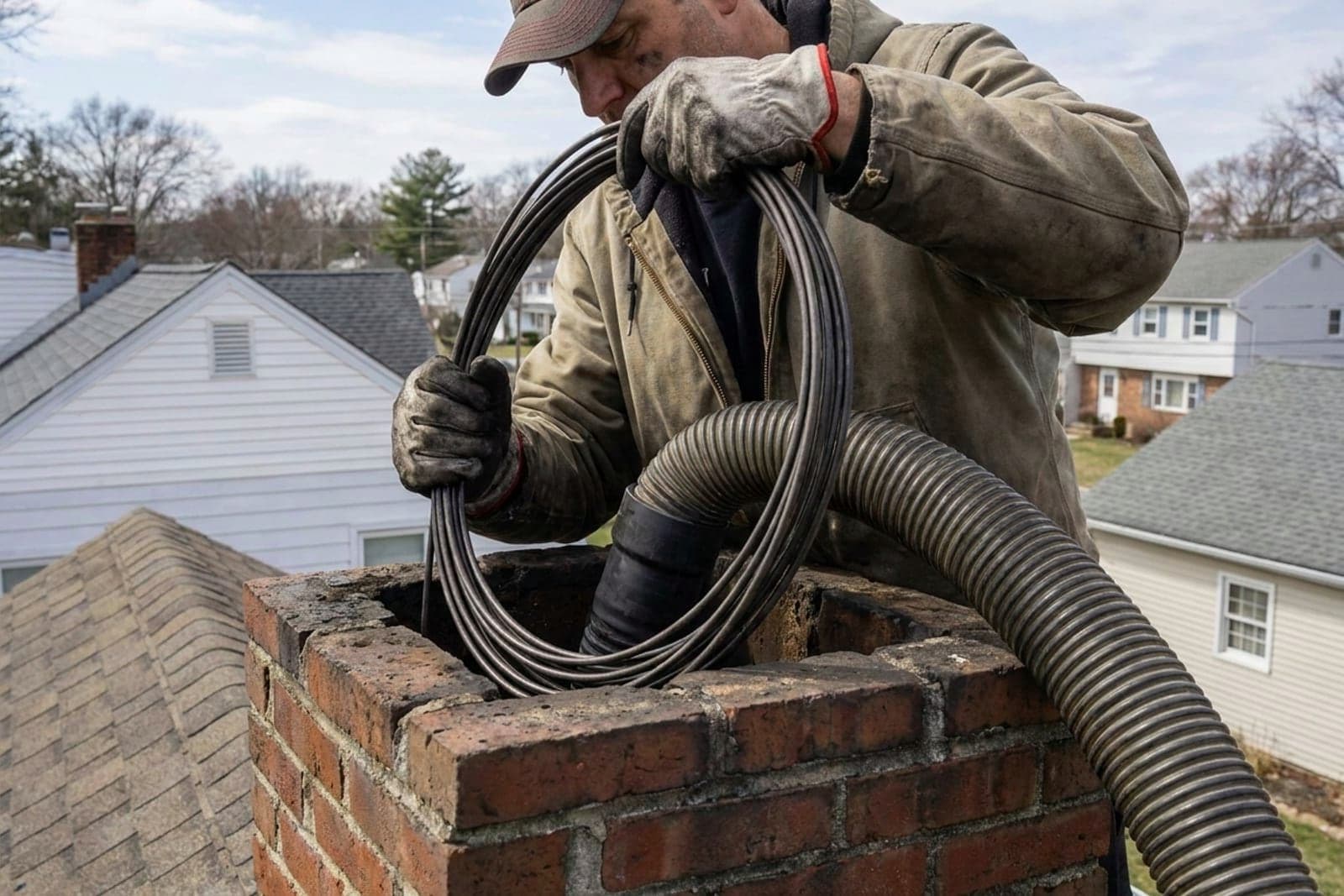
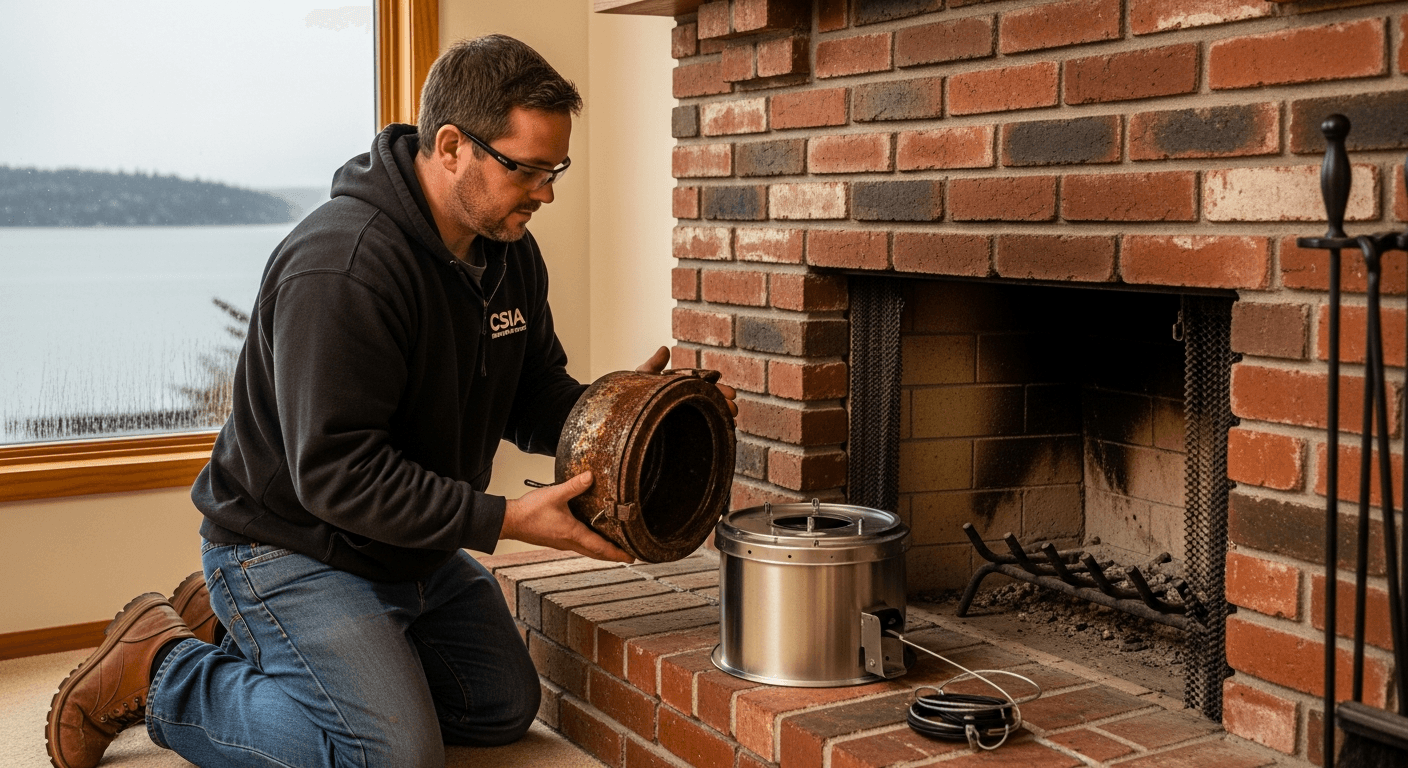
Upgrading to a top-mount damper is the standard recommendation for wood-burning fireplaces on the Eastside. Installation is completed in a single visit: the technician removes the old throat damper, confirms the flue is clear, and attaches the top-mount unit to the chimney crown with stainless-steel mounting brackets and a tamper-resistant cable running down to the firebox handle. The rubber gasket creates an airtight seal, and the mesh skirt blocks wildlife and debris. Most top-mount dampers carry a 10-to-15-year manufacturer warranty against gasket failure.
| Service | Typical Kirkland Price Range (2024–2025) | Key Notes |
|---|---|---|
| Throat damper adjustment / minor repair | $150 – $250 | Only appropriate if the frame is straight and plate rust is superficial — rare in homes built before 1995 |
| Throat damper full replacement (throat style) | $200 – $375 | Parts plus labor; pre-1980 firebox openings sometimes require a custom-cut plate, adding $50–$75 |
| Top-mount damper installation (standard flue) | $275 – $500 | Includes removal of old throat damper; most common damper service we perform in Kirkland |
| Top-mount damper on oversized or custom flue | $400 – $650+ | Common in 1970s–1980s Kirkland homes with larger-than-standard flue openings (over 13×13 in.) |
| Gas insert damper / flue adapter service | $175 – $400 | Requires gas-certified technician; do not attempt without proper credentials |
| Level 1 diagnostic inspection (credited toward same-day repair) | $99 – $150 | Covers visual assessment of damper, firebox, flue liner, and chimney crown |
A Kirkland homeowner's situation: a seized damper that had been open for two full winters
In early December, a homeowner in the Juanita neighborhood contacted us after noticing their living room felt inexplicably cold near the fireplace — even with the thermostat set to 70°F and heavy curtains drawn. They had not used the fireplace in two years and assumed the damper was closed. When our technician arrived and looked up into the firebox, the cast-iron throat damper handle had seized solid from rust. The plate was frozen at roughly a 30-degree angle — open enough that outdoor air had been channeling directly into the home for at least two consecutive heating seasons.
The house was a 1978 build with its original cast-iron throat damper, which is typical for Kirkland's established east-side neighborhoods. The frame had warped enough from decades of heat cycling and moisture exposure that adjusting the existing unit was not a sound long-term repair. We installed a stainless-steel top-mount damper the same morning, including the tamper-resistant cable, mounting hardware, and mesh wildlife skirt. The total invoice was $385 — credited against the $125 inspection fee the homeowner had already paid. The cold draft was eliminated within hours, and the homeowner estimated their December heating bill dropped noticeably compared to the prior year.
This scenario plays out multiple times every fall across Kirkland's older neighborhoods. Because the damper sits inside the firebox where it is rarely visible without a flashlight, a plate frozen open can go undetected for one, two, or three seasons — quietly inflating utility bills and letting conditioned air escape the entire time.
How to decide between repair and full replacement — a practical checklist for Kirkland homeowners
Repair makes sense when: the damper frame is dimensionally straight with no visible warping, the firebox throat shows no corrosion that has spread to the frame, the handle mechanism can be freed and still operates through its full range of motion, the damper is less than 15 years old, and your last inspection showed no moisture intrusion or cracking around the throat.
Replacement is the smarter choice when: the damper is original to a home built before 1990, the plate or frame shows visible rust pitting, warping, or cracks, you are already scheduling any other chimney service and want to avoid a second service-call fee, you want the rain-cap and pest-barrier benefits of a top-mount design, or a previous inspection flagged the damper as a maintenance item.
One Kirkland-specific consideration: the Puget Sound Clean Air Agency issues wood-burning restrictions on roughly 30–50 nights per year during still, cold weather when particulate levels rise. On those nights you cannot use the fireplace at all — but a sealed damper is still your only barrier against losing conditioned air up the flue. A broken damper costs you money on every restricted night, not just the nights you would have lit a fire.
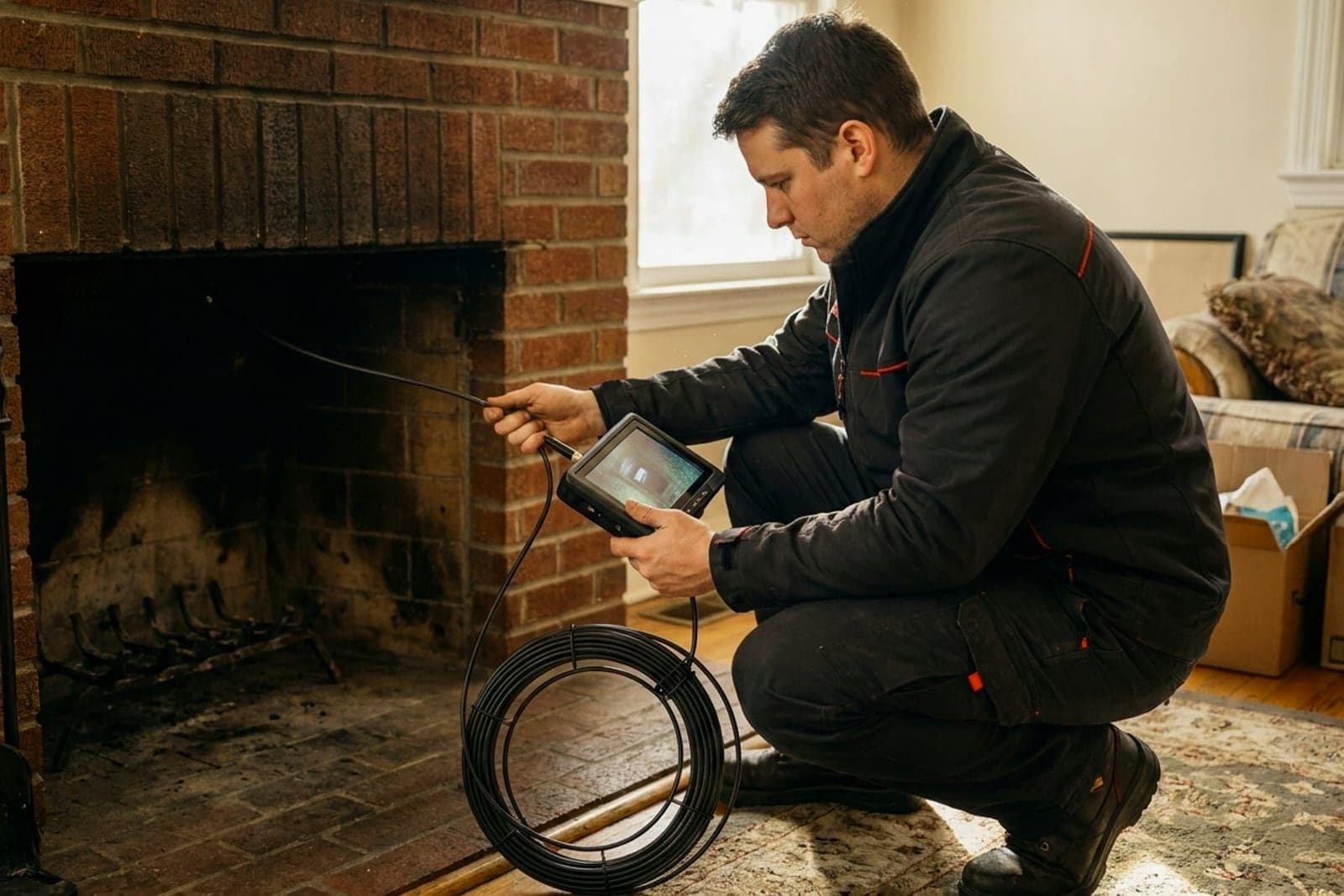
If you are uncertain about your damper's condition, the lowest-risk starting point is a Level 1 chimney inspection. Our technicians assess the damper, firebox, flue liner, and chimney crown in a single visit for $99–$150, and we credit that fee in full toward any repair booked the same day — so you never pay twice to solve the problem.
Frequently asked questions
How often should a chimney damper be inspected in Kirkland?
A chimney damper in Kirkland, WA should be inspected once a year, ideally in September or early October before heating season begins. Kirkland's wet climate — roughly 37 inches of annual precipitation, most of it concentrated between October and April — accelerates rust and warping on damper components. Annual inspections catch developing corrosion before it becomes a full damper failure.
How much does chimney damper replacement cost in Kirkland, WA?
Most Kirkland homeowners pay $200–$500 for a damper replacement in 2024–2025. A standard throat-damper swap runs $200–$375; upgrading to a top-mount damper — the most common recommendation for wood-burning fireplaces on the Eastside — costs $275–$500 installed. Oversized or custom flues in 1970s–1980s Kirkland homes can push the total to $650 or more.
Can I replace a chimney damper myself?
Lubricating a stiff damper handle is a reasonable DIY step for Kirkland homeowners. Replacing the damper itself — particularly a top-mount unit — requires safe roof access, correct flue-size measurement, and an airtight fit at the chimney crown. An improperly seated top-mount damper can leave gaps that reduce efficiency or, in a gas-appliance home, allow carbon monoxide to enter. For anything beyond handle lubrication, a CSIA-certified technician is the appropriate choice.
Is a chimney inspection worth scheduling just to check the damper?
Yes. A Level 1 chimney inspection in Kirkland at $99–$150 covers the damper, firebox, flue liner, and crown in one visit. In a Kirkland home older than 25 years, a single failed heating season with a stuck-open damper can cost more in wasted energy than the inspection fee — and the inspection confirms whether the damper is the only issue or part of a larger chimney problem.
What is a top-mount damper and is it better than a throat damper for Kirkland homes?
A top-mount damper mounts at the chimney crown and seals the Kirkland home's flue opening with a rubber gasket, doubling as a rain cap and wildlife barrier. Because it keeps Kirkland's frequent rain and debris out of the flue entirely, it outperforms throat dampers in this climate and typically carries a 10-to-15-year warranty against gasket failure. It is the standard recommendation for wood-burning fireplaces on the Eastside.
Related services