Few chimneys actually need to be replaced. Most of the brick stacks that worry Kirkland homeowners can be kept in service with repointing, a new crown or fresh flashing. A smaller number have reached the point where patching only buys a season: bricks rock under a hand above the roof, the stack leans, or the mortar has turned to sand. For those, the real choice is not simply rebuild or repair. It is between a like-for-like rebuild, a lighter rebuild above the roofline, a new liner inside the old shell, or taking the chimney out of service altogether. What follows helps you place your own chimney among those cases, covers the Washington code rules any new stack has to meet, and how the decision is usually priced.
Why so many Kirkland chimneys are reaching this question now
In recent American Community Survey data, Kirkland's median home dates from 1984, with about 43.6 percent of the city's housing built before 1980. Roughly 37 percent went up between 1960 and 1979 alone, the years when the 957-lot Kingsgate Highlands community was built out, from 1965 to 1976. A masonry chimney from those decades has now been through forty to sixty wet winters, and the top few feet, where it is exposed on every side, usually show it first.
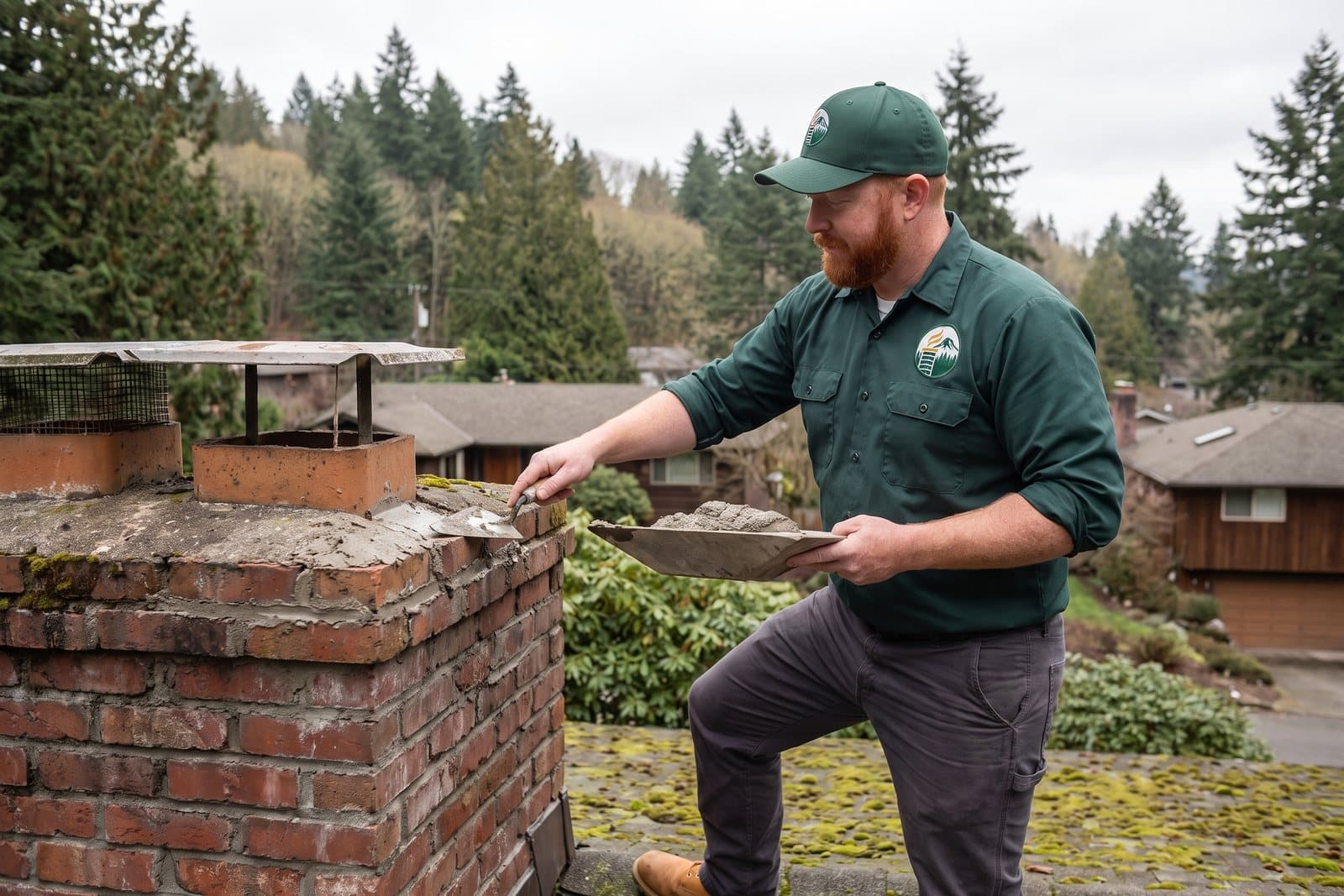
Age alone is not a reason to rebuild. The signs that move a chimney out of repair territory are structural: courses of brick that shift when pushed, a visible lean or a gap opening between the stack and the house, a crown that has broken into pieces, or joints that crumble to the touch across most of the exposed height. One of those, confirmed from the roof, is the point to start comparing options.
Earthquake risk and the case for going lighter
A heavy brick column that sticks up through a roof is the part of a house most likely to fail when the ground shakes. A 1996 USGS study concluded that the southern Whidbey Island fault, which comes ashore near Everett and runs southeast toward Woodinville, should be treated as capable of earthquakes of magnitude 7 or more. Washington Emergency Management has modeled a magnitude 7.4 event on that fault zone.
That is the argument for rebuilding above the roof with lighter materials when a stack must come down anyway: a listed metal flue inside a framed, sided chase weighs a fraction of the masonry it replaces. It changes the look of the house, so it is not the right answer everywhere, but it is worth pricing next to a brick-for-brick rebuild.
Four ways to deal with a failing stack
Each path suits a different chimney. The inspection is what decides which one yours is.
| Path | When it fits | What the work involves |
|---|---|---|
| Targeted repair | Sound structure with local damage | Repointing, a new crown, flashing or a cap |
| Rebuild above the roofline | Loose or cracked brick from the roof up, solid below | Take the stack down to firm masonry, relay it or frame a chase, new crown and flashing |
| Full rebuild | Damage running down through the attic or the firebox | Remove and rebuild the chimney and, often, the fireplace it serves |
| Reline inside the old shell | Brick is fine but the flue tiles are cracked | A stainless or poured liner sized to the appliance |
| Take it out of service | The fireplace is no longer used | Lower the stack below the roof, close the roof deck and seal the flue |
What a new chimney must meet under Washington code
The 2021 Washington State Residential Code has applied in King County to applications deemed complete since March 15, 2024. For chimneys it sets several rules a rebuild cannot skip. Height is fixed too: 3 feet over the roof where the stack exits, and 2 feet over any building part closer than 10 feet. A masonry chimney must be lined with clay flue tile to ASTM C315, a UL 1777 listed system or another approved liner. Broad stacks that sit below the ridge line must have a cricket built behind them so runoff is steered around the masonry.
A newer edition is on the way: Washington's code council has set Monday, May 3, 2027 for the 2024 books to take effect. If a rebuild is planned for that spring, ask which edition the permit will be reviewed under.
How the decision gets priced
We price general chimney repair between $425 and $3,700, the figure climbing with the volume of brick and mortar, and crown or repointing jobs run $475 to $3,200. A stainless liner is priced from $1,900 up to $5,900 depending on the height and the appliance it serves. A partial or full rebuild has no set figure, because the amount of brick to take down is only known once someone has stood on the roof.
That first visit is a $99 inspection, plus tax, and that fee is subtracted from the bill once you approve the work in our quote. You leave with photos of the stack, a clear statement of which of the paths above fits, and a written price for it.
Frequently asked questions
How tall does a rebuilt chimney have to be?
Under the 2021 Washington State Residential Code, a new stack must end at least 3 feet above where it leaves the roof, and top every piece of the house within 10 feet by at least 2 feet.
Can I take down a chimney I no longer use instead of rebuilding it?
Often, yes. A stack that serves nothing can be lowered below the roofline, the roof closed over it and the remaining flue sealed, which removes the part most exposed to wind, rain and shaking. The fireplace below is then out of service for good, so decide that first.
Who issues the permit for chimney work in the Northshore cities?
Kirkland, Bothell and Kenmore take permit applications through the regional MyBuildingPermit.com portal. Woodinville, which is not on that portal, says any fireplace or stove going in, moving or being swapped out needs a permit. Ask your contractor which permits the specific job needs before work begins.
Is a full rebuild on your price grid?
No. Repairs on our grid fall between $425 and $3,700, and relining runs $1,900 to $5,900. A full or partial rebuild is quoted only after someone has been on the roof and looked down the flue.
Sources
- Census Reporter — ACS year built — accessed September 29, 2026
- City of Kirkland — Kingsgate Neighborhood Plan — accessed September 29, 2026
- USGS — The southern Whidbey Island fault (1996) — accessed September 29, 2026
- WA EMD — Whidbey fault M7.4 model — accessed September 29, 2026
- UpCodes — Washington Residential Code 2021, Chapter 10 — accessed September 29, 2026
- WA SBCC — 2021 code effective date — accessed September 29, 2026
- WA SBCC — 2024 code schedule — accessed September 29, 2026
- MyBuildingPermit.com — member jurisdictions — accessed September 29, 2026
- City of Woodinville — Permitting FAQs — accessed September 29, 2026
Related services