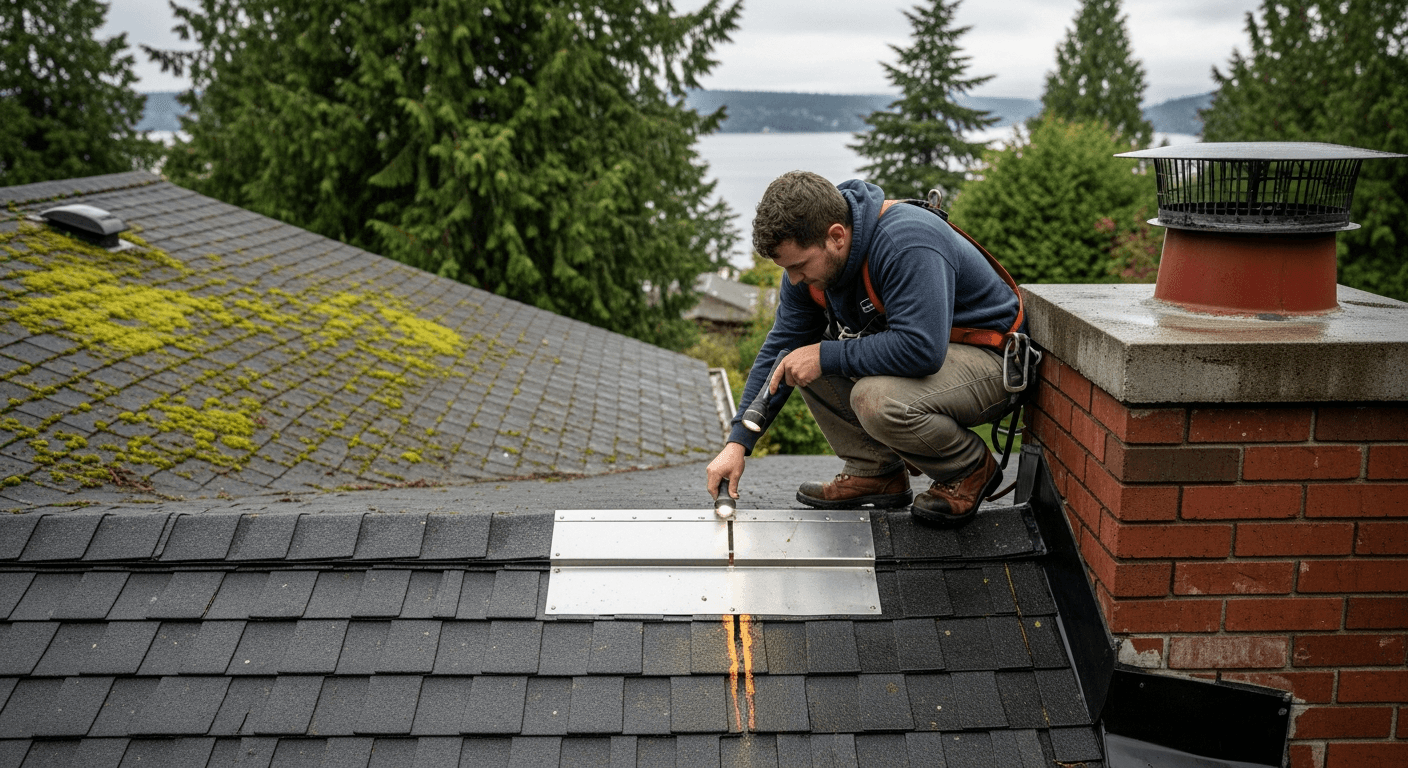
Failed or improperly installed flashing — the metal seal where your chimney meets the roofline — is the single most common cause of chimney leaks diagnosed in Kirkland homes, accounting for the overwhelming majority of cases we inspect. Left unaddressed through even one wet Eastside winter, a hairline flashing gap lets water wick into attic framing, stain interior ceilings, and rot the wood surrounding the firebox, turning a $400 repair into a $3,000 reconstruction job. Flashing problems are diagnosable in a single inspection visit and fixable, in most cases, in half a day — no roof tear-off required.
Why Kirkland Homes Are Especially Vulnerable to Chimney Leaks
Kirkland's position on the western shore of Lake Washington means sustained drizzle and dampness from October through March — not dramatic rainstorms, but relentless low-grade moisture that defeats chimney flashing more reliably than any single storm. Water works slowly into hairline gaps, freezes on cold nights above 500 feet elevation in the Bridle Trails and Totem Lake corridors, expands, and gradually pries the flashing away from the chimney's masonry or the roof deck.
Established neighborhoods like Juanita, Rose Hill, and Norkirk have homes built between the 1960s and 1980s with original lead or galvanized-steel flashing that is now 40-plus years old. That metal fatigues, and the roofing cement used to seal step flashing in that era has long since cracked. Newer construction in the Totem Lake and Kingsgate areas faces a different problem: homes built quickly during the mid-2000s boom sometimes have flashing that was undersized or improperly fastened from day one, and those installations are now entering their failure window.
Moss accumulation on chimney crowns — endemic on north-facing Kirkland rooflines — compounds the risk. Moss acts like a sponge, holding moisture directly against the chimney base and accelerating flashing corrosion. If you have had a moss treatment applied to your roof but never had the flashing inspected at the same visit, that is a gap worth closing before October.
What Chimney Flashing Repair Actually Costs in Kirkland
Flashing repair costs depend on how much of the system needs replacement, the material selected, and whether underlying wood rot or masonry damage must be corrected at the same time. The table below reflects current price ranges for Kirkland-area chimney flashing work on a standard single-flue residential chimney with a moderately pitched composition-shingle roof.
Stainless steel and copper flashing cost more upfront but outlast galvanized steel by 20 or more years in the Pacific Northwest's wet climate — a worthwhile upgrade for any Kirkland homeowner planning to stay long term. If a technician finds rotted roof-deck boards or deteriorated mortar at the chimney base during the same visit, those repairs are quoted separately. Catching them during a flashing job still costs far less than addressing them after a second winter of water infiltration.
| Service | Typical Price Range | Notes |
|---|---|---|
| Flashing re-seal (caulk and lap repair only) | $150 – $350 | Suitable for minor gaps only; a temporary measure on flashing older than 20 years |
| Step flashing replacement — galvanized steel | $400 – $700 | Full metal replacement along roofline; most common repair on Kirkland homes built before 2000 |
| Step flashing replacement — stainless steel | $600 – $950 | Recommended for Kirkland's climate; 40+ year service life vs. 15–20 for galvanized |
| Counter-flashing re-embed into mortar joints | $300 – $550 | Required when flashing has pulled away from brick or stone masonry |
| Full flashing system replacement — stainless or copper | $900 – $1,800 | Includes step, counter, and saddle/cricket; appropriate for chimneys over 30 in. wide |
| Flashing repair + Level 1 inspection combo | $300 – $600 | Confirms no secondary leak sources such as crown cracks or spalled brick |
| Wood rot repair (roof deck at chimney base) | $250 – $800 | Separate line item; scope and cost depend on how many deck boards are affected |
How Urgently Should a Kirkland Homeowner Act? Situation-by-Situation Inspection Frequency
Not every flashing situation carries the same urgency, and different home circumstances call for different inspection schedules. The table below matches common Kirkland homeowner situations to the recommended inspection frequency and typical action window so that each scenario can be evaluated on its own terms.
Homeowners in Juanita, Rose Hill, and Norkirk with original 1960s–1980s galvanized flashing should treat annual inspection as a baseline minimum — that metal is at or past its design life. Homes with a recent weather event (windstorm, falling limb, hailstorm) should schedule within days, not weeks, because prompt documentation is what a Washington State insurance adjuster will require. Proactive late-summer inspection before Kirkland's October rains begin is the most cost-effective posture for any chimney that has not been examined in the past three years.
| Situation | Recommended Inspection Frequency | Typical Action Window |
|---|---|---|
| Kirkland home built before 1990 — original flashing never replaced | Annually | Schedule before October; do not defer past first rain season |
| Home built during mid-2000s construction boom (Totem Lake, Kingsgate) | Every 2–3 years | Inspect now if flashing has never been evaluated; these installations are entering their failure window |
| Visible ceiling or wall stain adjacent to fireplace | Immediate — single inspection | Within the week; water in a wall cavity can produce mold in 48–72 hours |
| Recent covered weather event — windstorm, falling limb, or hailstorm | Immediate — Level 2 inspection | Within days; written report with photographs required for insurance claim |
| Moss present on chimney crown or north-facing roofline | After each moss treatment | Inspect at same visit as moss treatment or within 30 days |
| Wide masonry chimney (over 30 in.) — cricket/saddle status unknown | Once, then every 3 years | Before next rainy season; missing crickets are a direct driver of flashing failure |
| No known issues — routine maintenance on chimney under 20 years old | Every 3 years | Late August through mid-September for easiest scheduling and dry bonding conditions |
Will Homeowners Insurance Pay for Chimney Flashing Repair?
The honest answer is: sometimes — but rarely for the flashing itself. Standard Washington State homeowners policies cover sudden and accidental damage, not gradual deterioration. Flashing that has failed slowly over several rainy seasons is classified as a maintenance issue, which policies explicitly exclude.
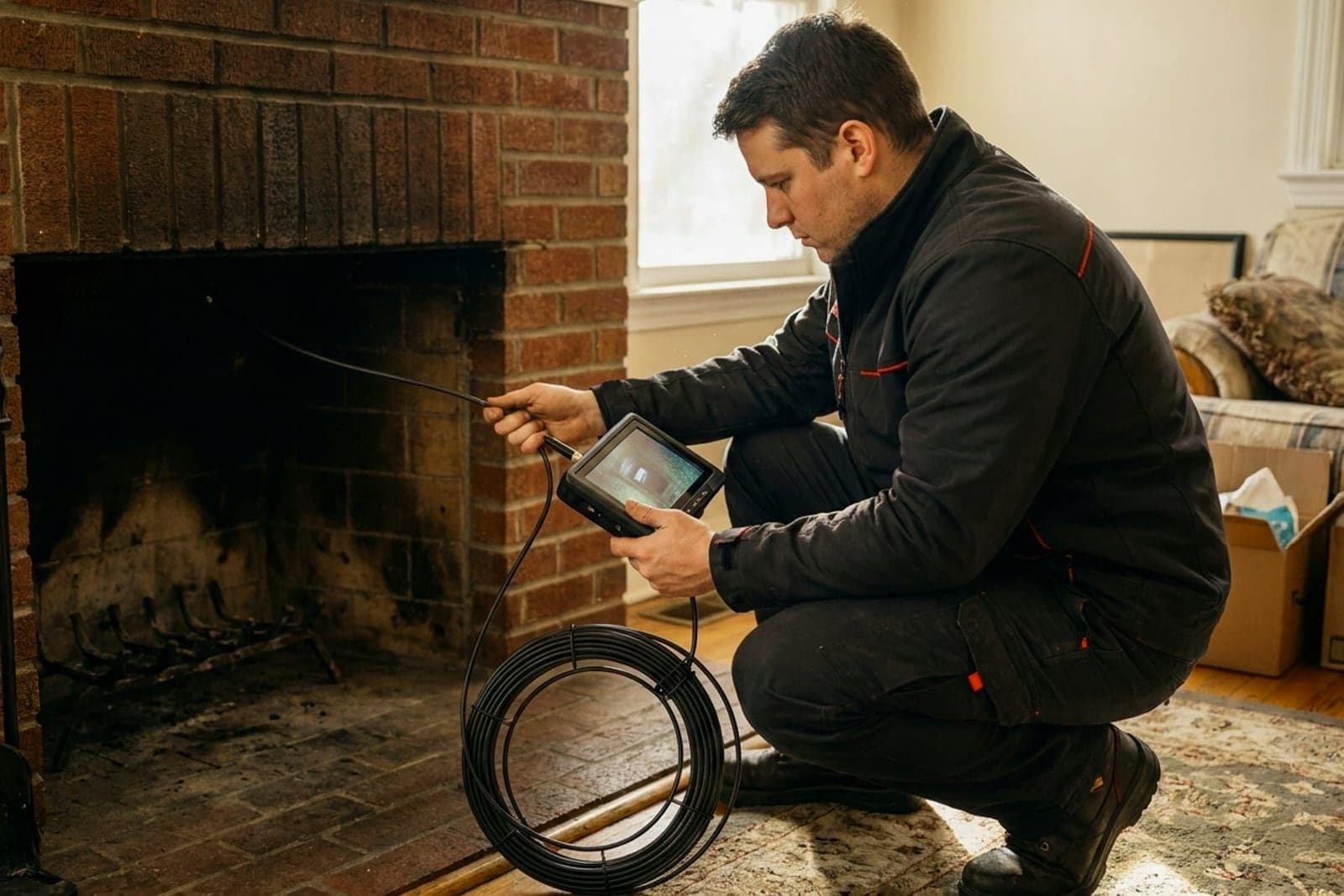
Where insurance steps in is when a covered event damages the flashing — a windstorm that peels back counter-flashing, a falling Douglas fir limb that bends step flashing out of position, or a hailstorm that punctures older galvanized metal. In those cases you have a legitimate claim, and a written Level 2 inspection report with photographs is precisely what your adjuster will request. A camera-assisted Level 2 inspection provides the documented evidence insurers require and costs $250 to $500 — a small investment compared to an unpaid claim.
There is also a coverage risk that runs the other direction: if you ignore a known chimney leak and it causes interior water damage, your insurer may deny that interior claim on the grounds of deferred maintenance. Prompt flashing repair protects both the structure and your policy. If a recent weather event may have caused the damage, ask your agent and then call us — we provide written inspection reports that support insurance claims.
Illustrative Scenario: The Ceiling Stain That Wasn't a Roof Problem
Consider a hypothetical Kirkland homeowner in the Finn Hill neighborhood — a situation representative of calls we receive regularly. A water stain spreads across the living-room ceiling during every multi-day rain event. The homeowner calls a roofer first. The roofer finds no missing or damaged shingles and reports the roof is sound. Confused, the homeowner calls Kirkland Chimney Pros.
In this type of scenario, our technician identifies the source within the first ten minutes on the roof: the step flashing along the southwest side of the chimney has separated from the counter-flashing above it, leaving a quarter-inch gap that directs water straight into the interior wall cavity each time rain arrives from the southwest — the prevailing storm direction in Kirkland. Original galvanized flashing from the mid-1990s has simply reached the end of its service life.
The appropriate repair in this situation is replacement of the full flashing system with stainless steel, re-embedding the counter-flashing into fresh mortar joints, and sealing the saddle on the uphill side of the chimney — a job typically completed in four hours. The takeaway: when a ceiling stain appears near a fireplace wall in a Kirkland home, always rule out chimney flashing before assuming the roof is the cause. Stainless steel replacement, priced between $600 and $950 for step flashing alone, is far less costly than the water damage that accumulates through additional rainy seasons.
The 3-2-10 Rule and Other Chimney Height Standards — How They Affect Leak Risk
The 3-2-10 rule, drawn from NFPA 211 and adopted in Washington State's residential building code, requires a chimney to extend at least 3 feet above the highest point where it exits the roof surface and at least 2 feet higher than any portion of the structure within a 10-foot horizontal radius. The rule is primarily a draft and fire-safety standard, but chimney height has a direct effect on leak vulnerability.
On Kirkland's hillside lots — particularly in the Bridle Trails, Highlands, and upper Rose Hill areas — rooflines are often complex, with multiple pitches, dormers, and ridge lines at varying heights. A chimney that falls short of the 2-foot clearance above a nearby dormer or ridge can create a downdraft zone that pressurizes the flue during southwest storms and pushes water up and under flashing. If your home has a dormer or secondary ridge within 10 feet of the chimney, confirming the 3-2-10 clearance is a routine part of any inspection we perform.
Separately, wide masonry chimneys — those exceeding 30 inches measured perpendicular to the roof slope — are required by code to have a saddle or cricket installed on the uphill side. A cricket is a small peaked diverter that sheds water away from the chimney base rather than pooling it at the flashing joint. Missing crickets are among the most frequent findings we document on Kirkland homes with large wood-burning fireplaces and are a direct and preventable driver of flashing failure.
How to Know When Flashing Repair Has Become Urgent
Not every flashing issue requires emergency scheduling, but the following signs mean you should not wait for your annual sweep: a water stain on the ceiling or wall adjacent to the fireplace; efflorescence (white mineral deposits) on exterior brick near the roofline; peeling paint or wallpaper inside near the firebox; a musty odor from the firebox that intensifies after rain; or rust streaks running down the exterior chimney face. Any one of these warrants a call within the week.
The optimal time for a proactive flashing inspection is late August or early September. Scheduling is easier before the fall rush, the roof and masonry are dry for proper bonding, and you are protected before Kirkland's October rains begin. If you are already seeing staining or drips mid-winter, do not defer. In the Pacific Northwest's damp climate, water inside a wall cavity can produce mold growth within 48 to 72 hours, and a same-week repair visit is reliably less expensive than mold remediation and drywall replacement.
Frequently asked questions
What is the 3-2-10 rule for chimneys?
The 3-2-10 rule, from NFPA 211 and Washington State's residential building code, requires a chimney to rise at least 3 feet above its roof exit point and at least 2 feet above any part of the building within a 10-foot horizontal radius. On Kirkland's hillside lots with complex rooflines, chimneys that fall short of this standard can experience downdraft pressure that drives rain up and under the flashing joint — compounding leak risk beyond normal weathering.
Will homeowners insurance pay for chimney flashing repair?
Chimney flashing repair in Kirkland is covered by homeowners insurance only in limited circumstances. Coverage does not apply to gradual deterioration, which Washington State insurers classify as a maintenance exclusion. Coverage does apply when a sudden covered event — a windstorm, falling tree limb, or hailstorm — damages the flashing. A written Level 2 inspection report with photographs is what adjusters require to process those claims. Additionally, ignoring a documented leak can give an insurer grounds to deny a related interior water-damage claim, so prompt repair protects your coverage.
How do I know whether my chimney is leaking through the flashing or somewhere else?
Flashing leaks in Kirkland homes typically produce staining on the ceiling or wall beside or above the fireplace, and the staining worsens during sustained multi-day rain rather than isolated downpours — consistent with how Kirkland storms arrive from the southwest. A cracked chimney crown causes water to appear inside the firebox itself. Condensation from a gas insert produces interior flue moisture without an obvious exterior leak path. A professional inspection distinguishes between these sources in a single visit and prevents unnecessary roofing work.
What does a Level 2 chimney inspection cost in Kirkland?
A Level 2 chimney inspection in Kirkland typically runs $250 to $500. It includes a camera scan of the full flue interior and a written report with photographs — the level required after any suspected damage event, before a home sale, or when supporting an insurance claim. It costs more than a Level 1 visual inspection but produces the documented evidence that adjusters and real-estate transactions require.
When is the best time of year to schedule flashing repair in Kirkland?
Late August through mid-September is the ideal window to schedule chimney flashing repair in Kirkland. Roof surfaces and mortar joints are dry during that period, allowing sealants and mortar to cure properly. Scheduling is also easier before the October demand surge. If staining or drips are already present at any time of year, Kirkland homeowners should call immediately — water in a wall cavity can cause mold in as little as 48 to 72 hours in Kirkland's climate, and a prompt repair is far less expensive than remediation.
Related services