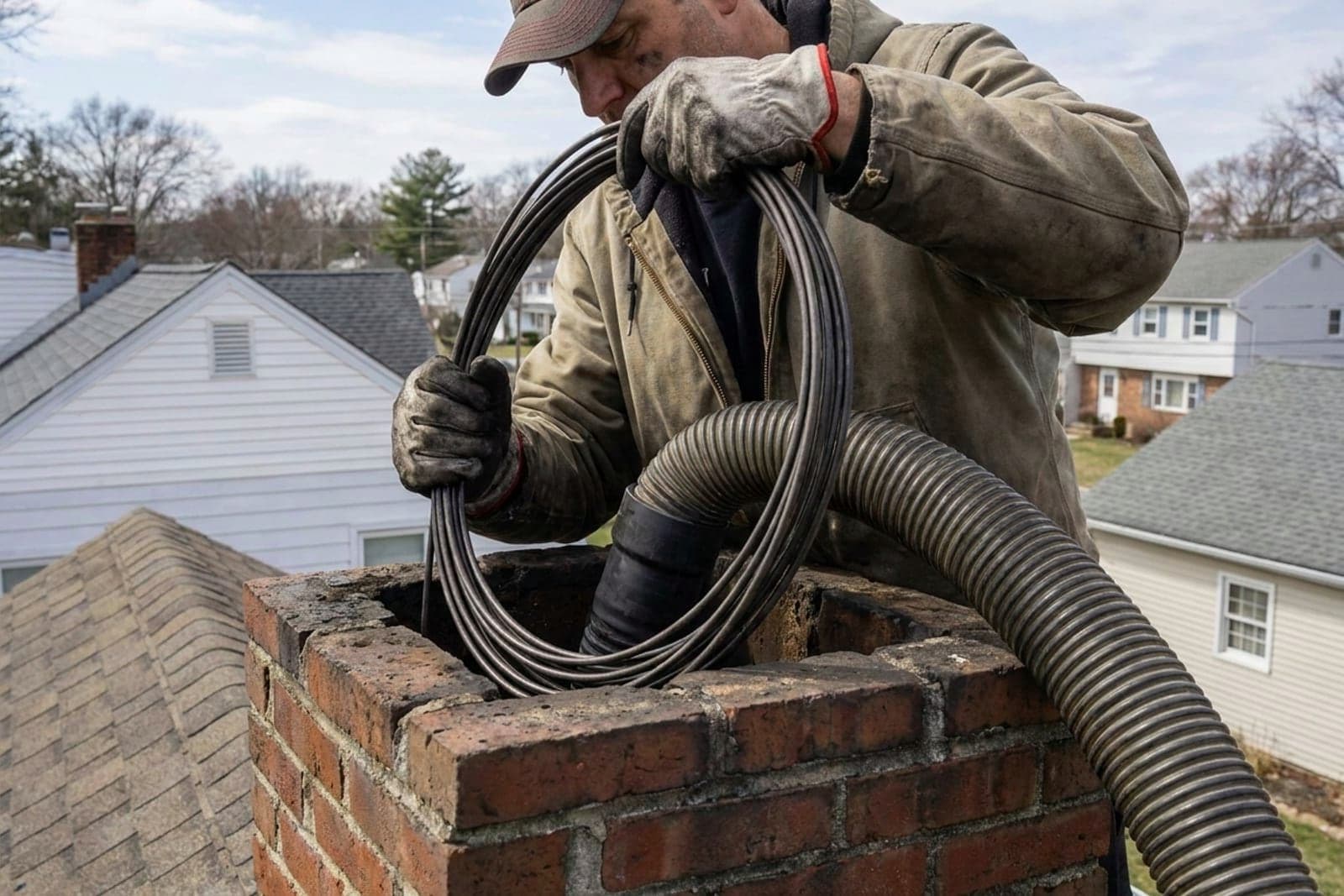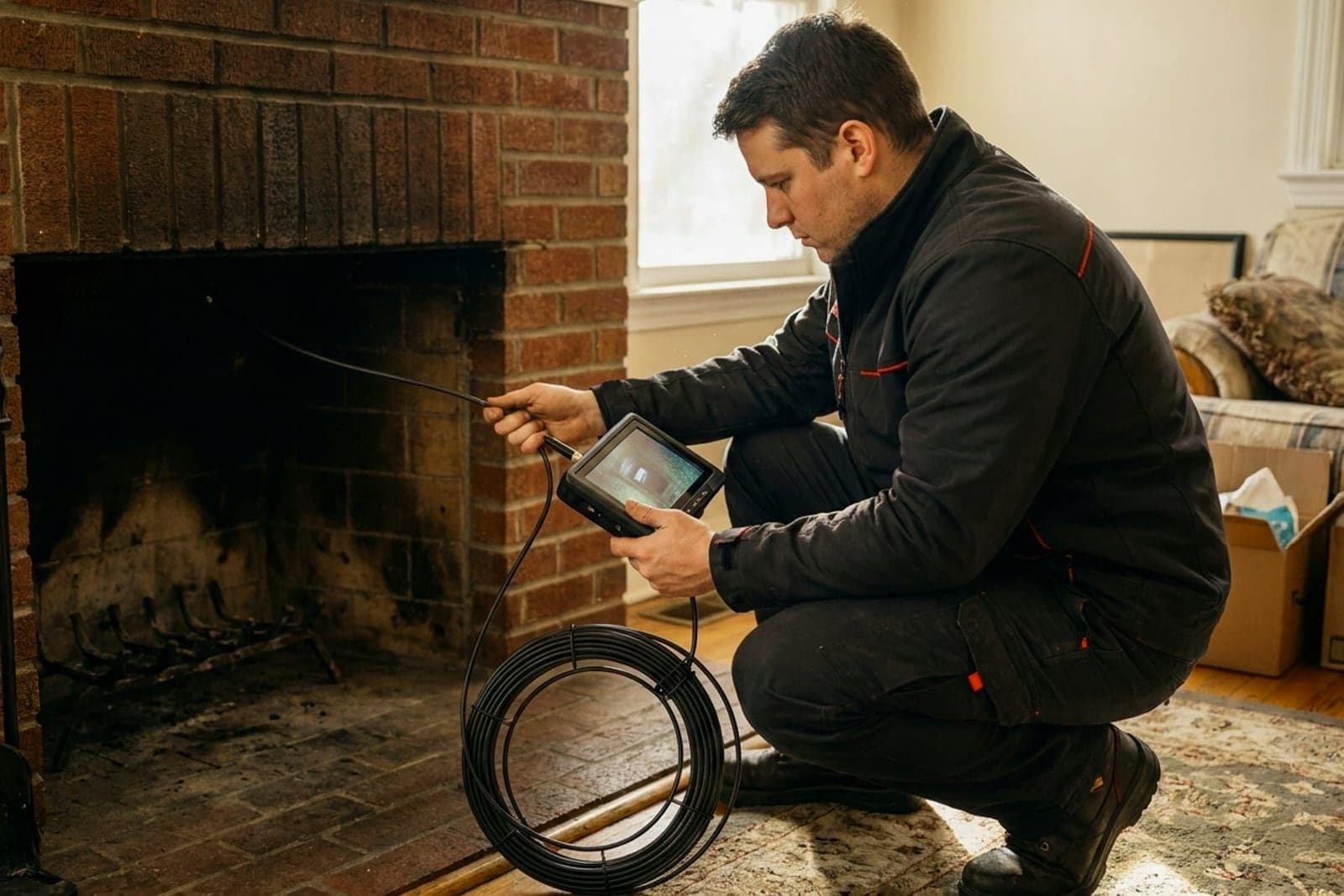
Removing creosote from a chimney requires a certified sweep using rotary brushes, chemical pre-treatments, or chain flail systems — it is not a DIY task and should not be attempted without professional equipment. In Kirkland, where Lake Washington shoreline temperatures regularly drop into the low 30s from November through February and damp air slows combustion temperatures inside the flue, most wood-burning fireplaces accumulate enough creosote in a single heating season to meet the NFPA 211 cleaning threshold before the next one begins.
What Is Creosote and Why Does Kirkland's Climate Make It Worse?
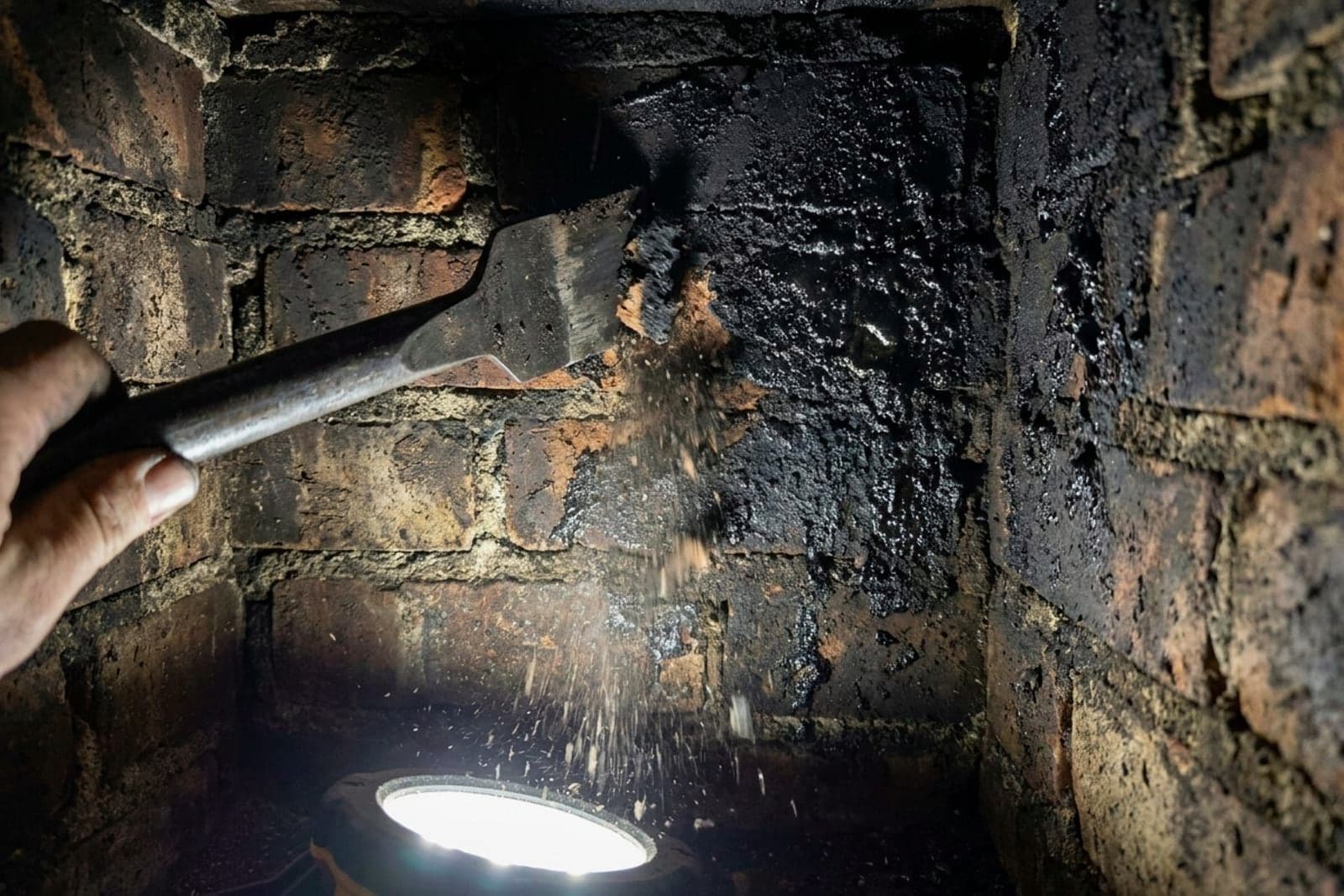
Creosote forms when smoke cools before fully exiting the flue, causing unburned hydrocarbons to condense on the liner walls as a dark, flammable residue. It progresses through three stages: a dry, flaky Stage 1 deposit; a sticky, tar-like Stage 2 layer; and a rock-hard, glazed Stage 3 crust that is both extremely difficult to remove and genuinely dangerous.
Kirkland's climate accelerates every stage of that progression. Flue gases cool faster when outside temperatures hover in the 30s — a regular occurrence here from mid-November through late February — which drives condensation onto the liner before smoke can fully exit. That same persistent dampness means firewood sold locally as 'seasoned' often tests above 25 percent moisture content, when it should be below 20. Wet wood burns at lower combustion temperatures and produces three to four times more creosote per cord than properly dried wood. In practical terms, a Kirkland homeowner burning three to five fires per week through a typical heating season can accumulate a quarter-inch or more of Stage 2 buildup — the threshold at which NFPA 211 calls for immediate cleaning — before March.
The Three Methods Professionals Use to Remove Creosote
Stage 1 creosote — dry, flaky soot — is removed with stiff polypropylene or wire chimney brushes sized precisely to your flue dimensions. A sweep works top-down, pushing debris into the firebox, then extracting everything with a HEPA-filter vacuum to keep fine particulate out of your living space.
Stage 2 creosote requires rotary cleaning systems: flexible drill-driven rods tipped with spinning brushes or chain flails that chip away the tar-like layer hand brushes cannot touch. For heavy Stage 2 deposits, a sweep will typically apply a powdered chemical dissolvent — usually a sodium hydroxide compound — and ask you to burn one or two small fires over several days to dry and partially break down the tar before the rotary cleaning appointment. That two-step process is standard practice for many Kirkland homes inspected after a skipped season.
Stage 3 glazed creosote is the most serious situation a sweep encounters. It requires multiple applications of a professional-grade chemical dissolvent combined with aggressive rotary cleaning, and in severe cases the liner itself must be evaluated for relining with a stainless-steel insert. Glazed creosote ignites above 1,000 degrees Fahrenheit; chimney fires fueled by Stage 3 deposits routinely exceed 2,000 degrees and can crack a terra-cotta liner within minutes of ignition.
A Hypothetical Kirkland Homeowner Situation: When 'Just One More Winter' Backfires
Consider a hypothetical homeowner in the Juanita neighborhood who notices a sharp, acrid smell drifting into the living room each time the wood-burning fireplace is used. The homeowner purchased a 1978 ranch-style home two years earlier and has not scheduled a chimney inspection since moving in, assuming the previous owners kept up with annual sweeps.
A sweep in this scenario might find nearly a half-inch of Stage 2 creosote lining the flue — sticky, tar-like, and beginning to harden toward Stage 3 in two sections near the smoke chamber. The original terra-cotta liner could be structurally intact, but the buildup would have narrowed the effective flue diameter enough to restrict draft, explaining exactly why smoke pushes back into the room. The standard approach is to apply a chemical pre-treatment, have the homeowner burn two small fires over the following week to partially dry the deposit, then complete a rotary cleaning that takes approximately two and a half hours on the appointment day — from first call to a clean, fully usable fireplace: about eight days. Had the homeowner burned through one more Kirkland winter without cleaning, the hardening Stage 3 sections would almost certainly have required full relining — a cost four to six times higher than the chemical treatment and sweep needed at the Stage 2 point.
How Often Should Kirkland Homeowners Schedule Creosote Removal?
NFPA 211 sets the threshold at one-eighth of an inch of buildup — at that point, cleaning is required regardless of how recently the last sweep occurred. For a Kirkland homeowner burning wood three to five times per week from October through March, that threshold is typically reached within a single heating season. Book your sweep every September or early October, before Puget Sound Clean Air Agency wood-burning restrictions and the first cold snaps send everyone scrambling. October and November appointments at our shop fill within days of opening the fall schedule.
If you burn fewer than a dozen fires per year, a cleaning every two years may be sufficient — but the flue should still be visually inspected annually so gradual buildup does not go undetected. Gas fireplace inserts produce negligible creosote but do generate moisture and debris; those flues should be cleared every two to three years. And if you experience a chimney fire of any size — including what sounded like an unusually loud, roaring burn — stop using the fireplace immediately and schedule an inspection before the next fire.
| Usage pattern in Kirkland | Fireplace type | Recommended cleaning frequency |
|---|---|---|
| 3–5 fires per week, October–March | Wood-burning fireplace or insert | Every year (annually before October) |
| Fewer than 12 fires per year | Wood-burning fireplace or insert | Every 2 years; inspect annually |
| Regular use, any frequency | Gas fireplace insert | Every 2–3 years; inspect annually |
| Any use, any frequency | Any type, after a suspected chimney fire | Immediately — before next fire |
| Skipped one or more seasons | Wood-burning fireplace or insert | Immediately — camera inspection required |
Can You Reduce Creosote Buildup Between Professional Cleanings?
The single most effective step is burning wood with a moisture content below 20 percent. In Kirkland's climate, wood stacked outdoors without cover often stays wet well into its second year — even wood marketed as seasoned. Use an inexpensive wood moisture meter to test before burning, and stack firewood under a covered area with good airflow for at least 12 months. Wood cut and delivered locally in spring is rarely ready to burn safely the following fall without covered storage.
Burn hot, shorter fires rather than slow, smoldering ones. Keeping flue temperatures above 250 degrees Fahrenheit substantially reduces condensation on the liner; a magnetic stovepipe thermometer costs around $20 and lets you monitor this in real time on a wood stove. Creosote-sweeping logs available at grocery and hardware stores do have a mild chemical action on Stage 1 deposits and can reduce what your sweep has to deal with at the annual appointment — but they are a supplement to professional cleaning, not a replacement for it.
What Happens If You Ignore Creosote Buildup?
A chimney fire — not as a worst-case scenario but as a statistically predictable outcome. The Chimney Safety Institute of America estimates creosote accounts for the majority of roughly 25,000 residential chimney fires reported in the U.S. each year. Many homeowners never realize a chimney fire occurred; it can burn fast and intensely inside the flue, crack the liner, and leave the chimney structurally compromised — discovered only during a later inspection.
A cracked or spalled terra-cotta liner allows heat and combustion gases, including carbon monoxide, to migrate into surrounding framing. In Kirkland, homes built in the 1960s and 1970s — common throughout the Finn Hill and Holmes Point neighborhoods — frequently have wood framing positioned closer to the chimney chase than current building codes permit. That combination of a heat-damaged liner and dense older framing is precisely how a neglected flue becomes a structural house fire. Scheduling annual creosote removal is, in that context, one of the lowest-cost forms of home protection available to a Kirkland homeowner.
What Does Creosote Removal Cost?
Creosote removal pricing depends almost entirely on the stage of buildup. A light Stage 1 accumulation comes off during a standard chimney sweep, while hardened Stage 3 glaze can require chemical treatment across multiple visits. Waiting a season rarely saves money — buildup only gets harder and more expensive to remove.
These are typical ranges for the Kirkland and Eastside market. An exact written quote follows a camera inspection of the flue, so you know the stage — and the price — before any work starts.
| Creosote stage | Removal method | Typical cost |
|---|---|---|
| Stage 1 — light, sooty dust | Standard sweep with rotary brush | $150–$300 |
| Stage 2 — dry, flaky tar | Rotary brush + chemical pre-treatment | $300–$500 |
| Stage 3 — hardened glaze | Chain flail or PCR chemical, sometimes multiple visits | $500–$800+ |
Frequently asked questions
How much does creosote removal cost?
Between $150 and $300 for a Stage 1 cleaning done as part of a standard chimney sweep, $300–$500 when a chemical pre-treatment is needed, and $500–$800+ for hardened Stage 3 glaze. Annual maintenance keeps most Kirkland homes at the low end of that range.
Can I remove creosote from my chimney myself?
No — consumer brushes and fireplace logs cannot remove bonded Stage 2 or Stage 3 creosote from a chimney, and DIY scraping can damage the flue liner. Professional creosote removal uses rotary equipment, chain flail systems and controlled chemical treatments, and it documents the flue's condition for your insurance.
Do creosote sweeping logs actually work?
Creosote sweeping logs help loosen light deposits and can make a professional cleaning easier, but they do not remove creosote from the flue — the residue still has to be mechanically swept out. Treat them as a supplement between professional cleanings, never a replacement.
How often should creosote be removed?
NFPA 211 calls for a chimney inspection every year, with cleaning as soon as buildup reaches about 1/8 inch. For Kirkland homes that burn wood regularly through the long, damp Pacific Northwest heating season, that works out to a professional creosote cleaning every year — ideally in late summer before the burning season starts.
What is Stage 3 (glazed) creosote and why is it harder to remove?
Stage 3 creosote is a hardened, shiny tar glaze created when fresh deposits bake onto earlier layers inside the flue. It is highly concentrated fuel — chimney fires feeding on Stage 3 glaze can exceed 2,000°F — and brushes alone cannot break it, which is why removal requires chain flail equipment or specialized chemical treatment by a professional sweep.
Related services