A gas fireplace that won't stay lit, produces a weak flame, or emits an unfamiliar odor almost always needs a professional cleaning and tune-up — not a new unit. In Kirkland, where Lake Washington humidity keeps moisture levels elevated year-round, skipping annual service accelerates corrosion on pilot assemblies and burner components fast enough to turn a minor tune-up into a costly mid-winter repair call.
Why Gas Fireplaces Still Need Annual Service (Even Without Creosote)
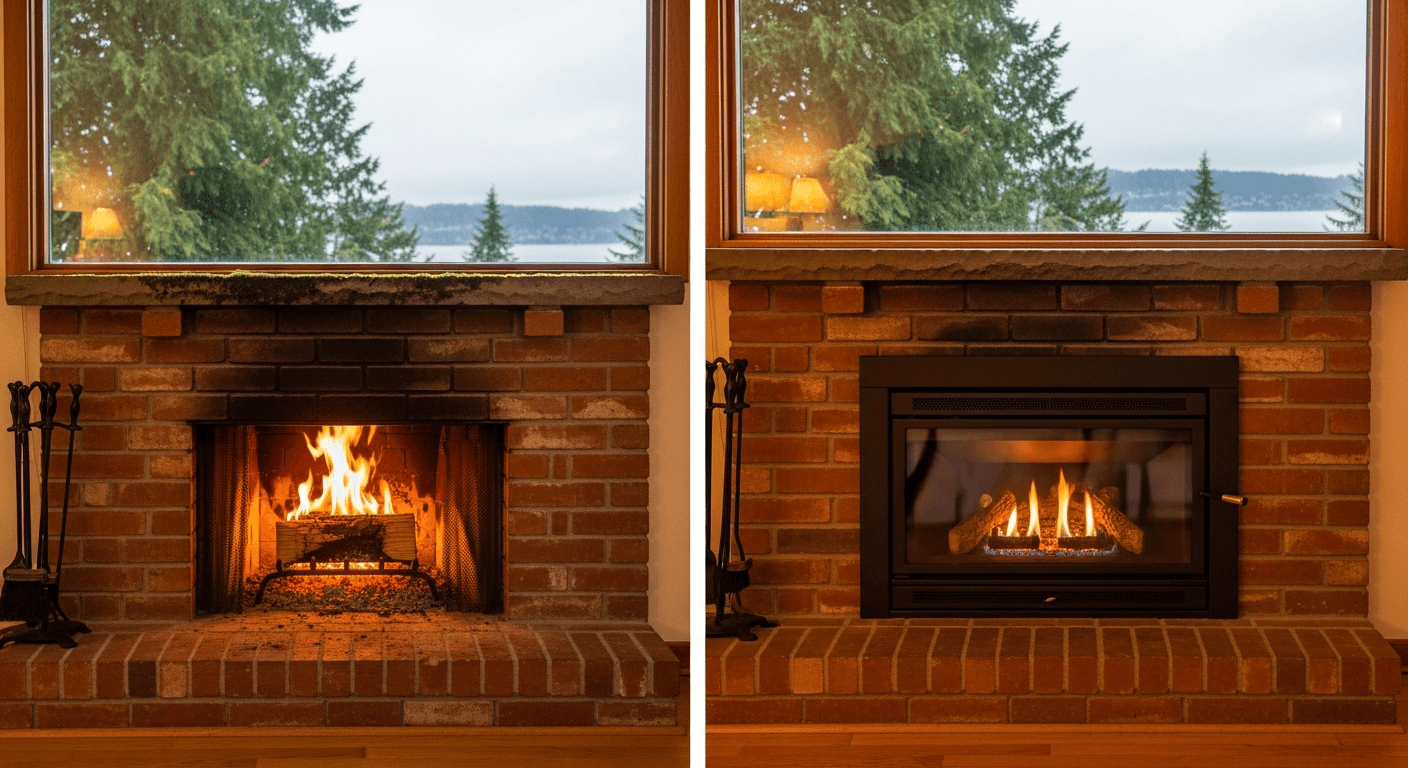
Many Kirkland homeowners assume that switching from wood to a gas insert eliminates the need for annual maintenance. It doesn't — it changes what the technician is looking for. Gas appliances don't produce creosote, but over a Kirkland spring and summer, burner ports collect dust and spider webs, and the pilot assembly accumulates the fine rust film that forms when humid air condenses inside a firebox that hasn't been fired in months.
Kirkland's position between Lake Washington and Puget Sound keeps relative humidity above 80 percent on most fall and winter mornings. That moisture infiltrates even well-sealed venting systems, attacking the gasket seals on direct-vent inserts and accelerating oxidation on thermocouple probe tips. A technician catches this during a routine cleaning; left unaddressed, it typically produces a nuisance no-heat call in November when scheduling is tight and parts may need to be ordered.
There is also a regulatory dimension specific to this area. The Puget Sound Clean Air Agency issues wood-burning curtailments throughout the winter heating season, and many Kirkland households installed gas inserts specifically to stay exempt from those restrictions. A gas insert that misfires on a curtailment day doesn't just leave you cold — it eliminates the compliant heating option you paid to have.
Most gas fireplace manufacturers also tie warranty coverage to documented annual service. Kirkland saw a significant wave of home renovations and addition projects between roughly 2005 and 2015, and many of those inserts are now 10 to 18 years old — still within or just past their stated service life, but vulnerable to warranty voidance if service records have lapsed.
What a Professional Gas Fireplace Service Actually Includes
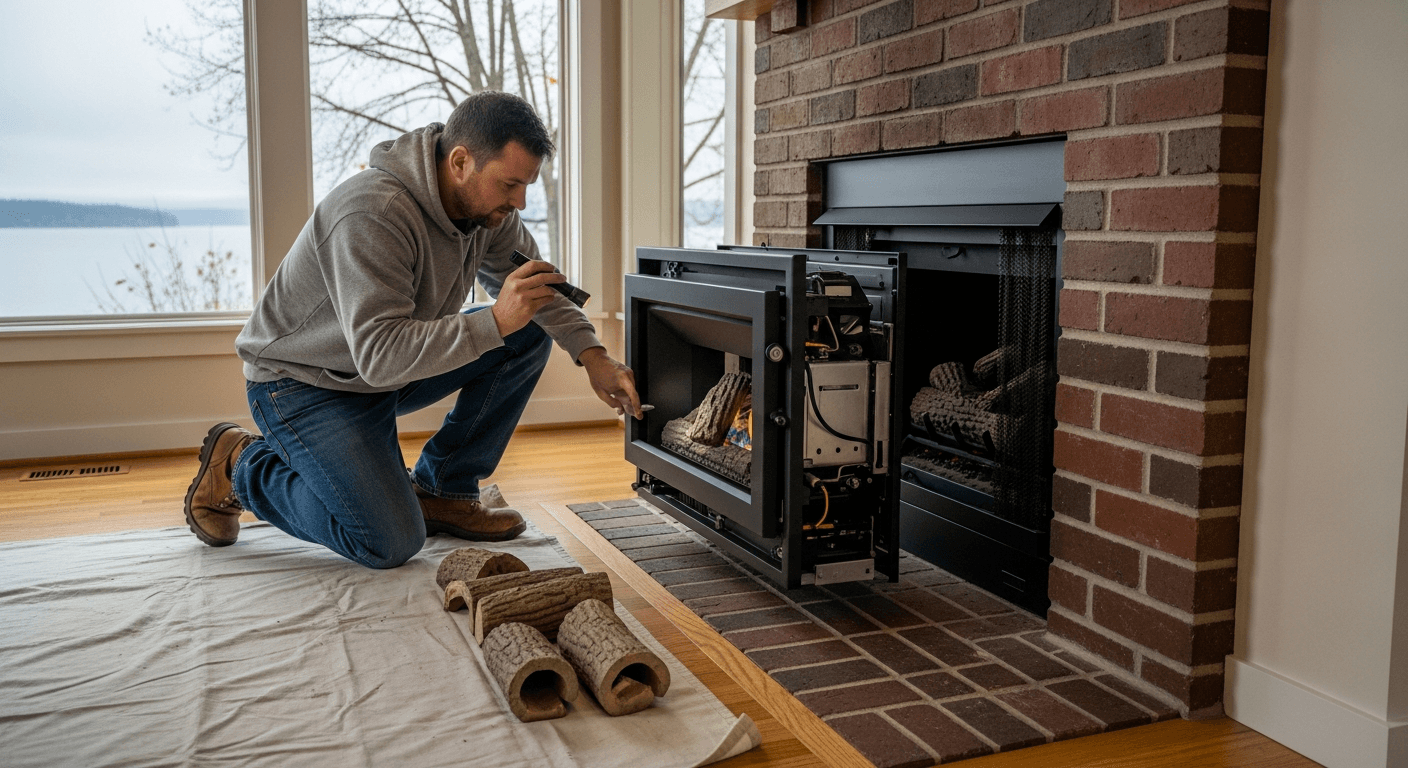
A complete gas fireplace or insert service begins with removing the decorative front panel and log set, then vacuuming the burner compartment of accumulated dust, spider webs, and debris. Ceramic and refractory logs are individually brushed and wiped down. The glass panel is cleaned with a fireplace-specific solution that removes the white combustion haze that builds up over a heating season — haze that ordinary window cleaner won't touch and that significantly dims the visual appeal of the fire.
The pilot assembly and thermocouple are inspected for corrosion, then tested with a multimeter for millivolt output. A thermocouple producing less than roughly 25 millivolts will not hold the gas valve open reliably — the most common single cause of a gas fireplace that lights briefly and then shuts off. Catching a marginal thermocouple during a routine visit costs a fraction of an emergency call. The gas valve itself is checked for smooth operation, and the ignition system — standing pilot or electronic — is cycled multiple times to confirm consistent ignition.
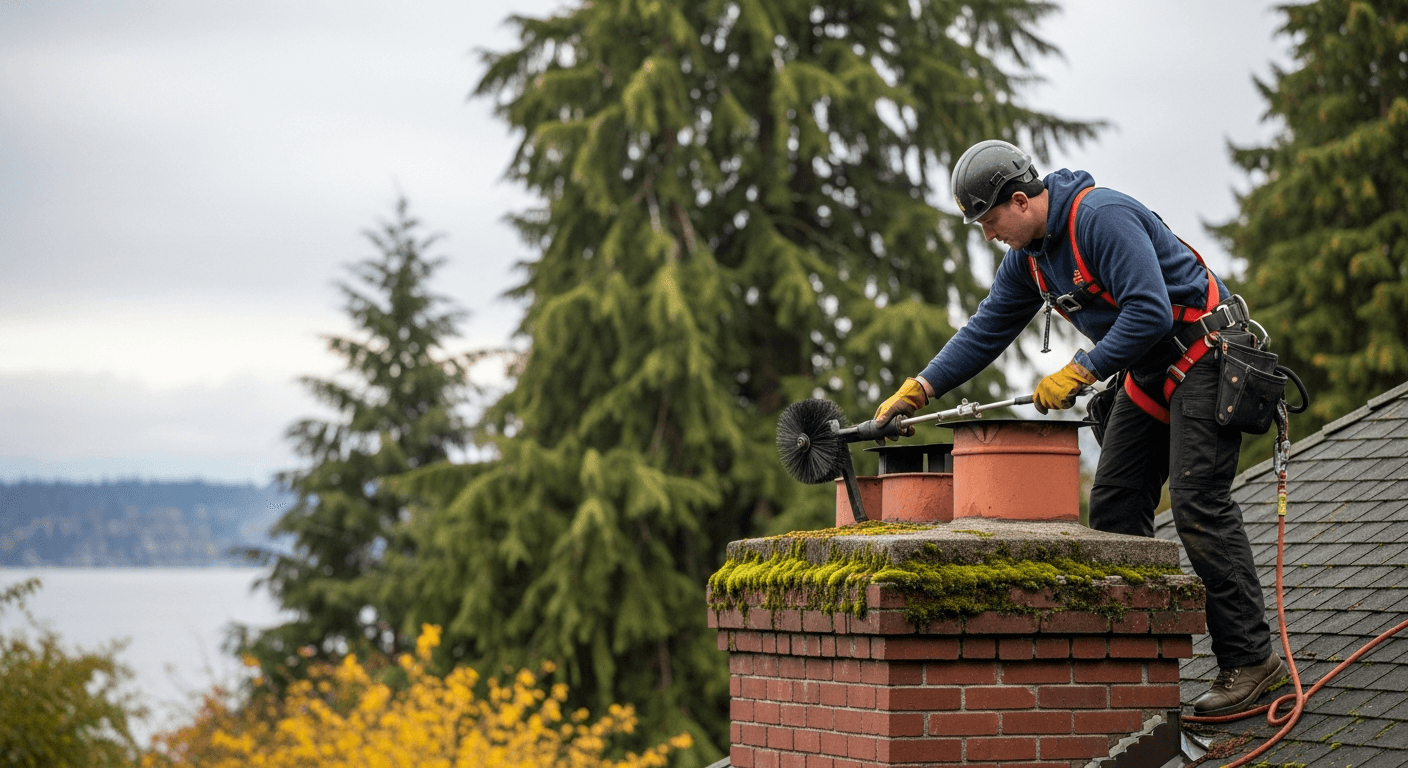
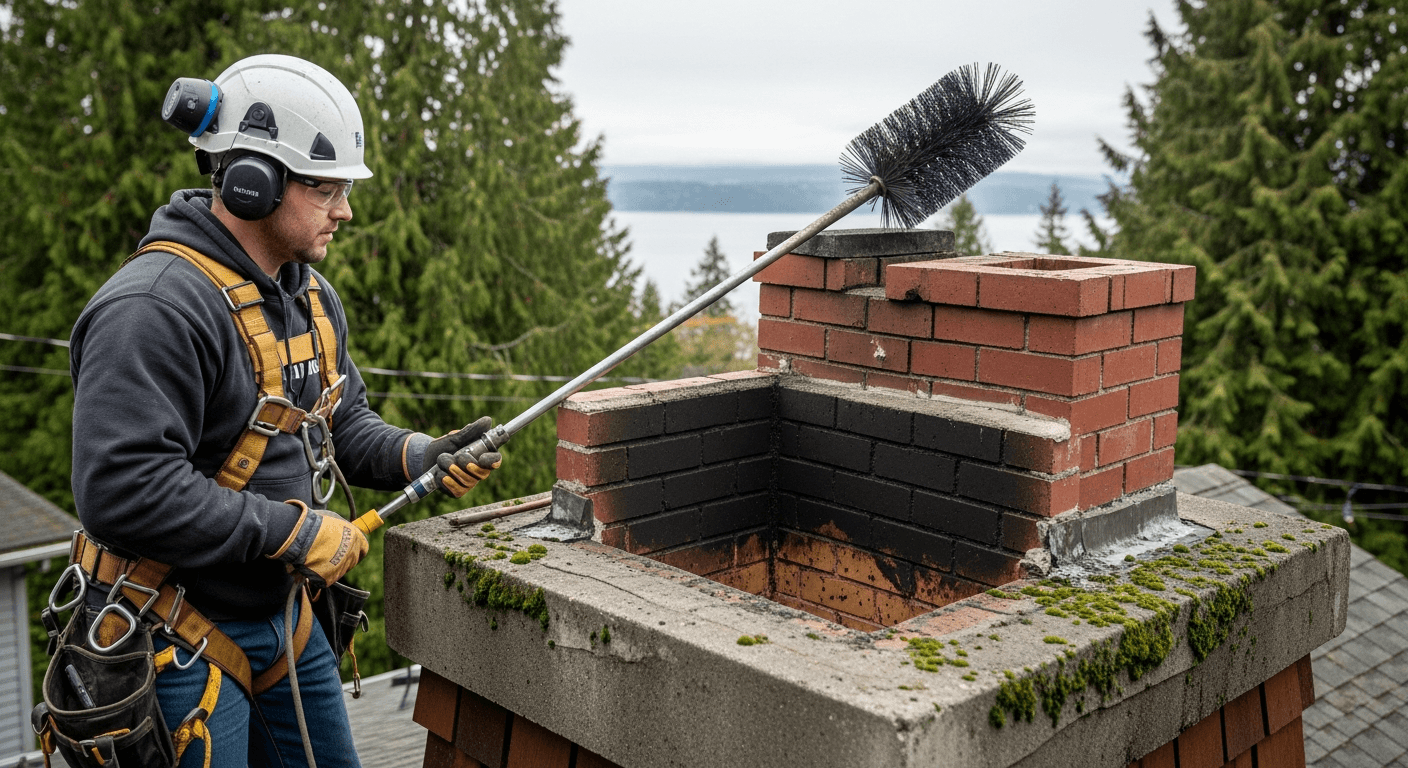
Venting inspection is a step that cut-rate service calls frequently omit. Gas inserts installed in Kirkland homes use one of two systems: direct-vent, with a sealed co-axial pipe that draws combustion air from outside and exhausts gases through the same penetration; or B-vent, which relies on the existing masonry flue. In homes along the Juanita, Holmes Point, or Finn Hill corridors where older masonry chimneys were converted to gas in the 1990s or early 2000s, the liner, rain cap, and termination point require direct examination to confirm carbon monoxide cannot back-draft into occupied space.
The technician also inspects the refractory panels lining the firebox for cracks. Hairline cracks from thermal cycling are normal; cracks wider than a credit card or that penetrate through the panel allow radiant heat to reach the framing behind the firebox. Identifying and replacing a cracked panel during a routine service is straightforward. Discovering one after it has caused structural damage is not.
Gas Fireplace and Insert Service Costs in Kirkland WA
Pricing in the Kirkland and broader Eastside market depends on appliance type, venting complexity, and whether any components need replacement during the visit. The table below reflects current 2024–2025 ranges for this service area.
Parts replacements — thermocouple, thermopile, igniter, or gas valve — are billed separately and vary by brand and model. Allow an additional $40 to $180 for common wear parts if the technician identifies a failing component. If your insert is more than 15 years old, ask upfront whether replacement parts are still in production for your model before authorizing repairs that approach the cost of a new unit.
| Service Type | Typical Price Range (Kirkland/Eastside) | What Is Included |
|---|---|---|
| Gas fireplace cleaning and tune-up (freestanding or built-in) | $120 – $185 | Burner vacuum, glass clean, log set clean, ignition cycle test, visual venting check |
| Gas insert full service (insert pulled from firebox surround) | $175 – $260 | All above plus insert removal, liner and re-seal inspection, surround gasket check |
| Thermocouple or thermopile replacement (parts + labor) | $85 – $160 | New part installed, millivolt output verified, pilot hold-in test |
| Gas valve replacement (parts + labor) | $200 – $380 | New OEM or compatible valve, inlet pressure test, full ignition cycle confirmation |
| Direct-vent termination cap inspection and cleaning | $65 – $110 | Spider-screen removal and cleaning, cap integrity check, co-axial seal inspection |
| Carbon monoxide and gas leak safety check (add-on) | $35 – $60 | Combustion analyzer reading at flue, ambient CO test in room, gas connections checked with detector |
A Juanita-Area Homeowner's Experience: When 'It Just Needs a Cleaning' Saved the Day
In late October, a homeowner near Juanita Beach called us a week before the first serious cold snap of the season. Their gas insert had worked reliably the previous winter but was now igniting, running for roughly 30 seconds, and shutting off. They had already contacted the gas utility, which checked the meter and confirmed normal supply pressure.
When our technician pulled the insert fully out from its surround — a step the homeowner had never seen performed — the problem was immediately visible. The thermocouple probe tip was coated in a combination of fine dust and a thin rust film from condensation that had formed inside the firebox during the previous summer. The coating was preventing reliable thermal contact with the pilot flame, triggering the gas valve's safety shutoff.
The technician cleaned the probe, retested millivolt output — which came back within spec — and repositioned the thermocouple slightly closer to the pilot flame per the manufacturer's bracket tolerance. He also cleaned the glass panels, which had developed a heavy white haze, and repositioned two ceramic logs that had shifted and were producing an uneven, lazy flame. Total time on site: about 90 minutes. The homeowner had been pricing replacement inserts online before the call. The actual cost was a single service fee.
When to Schedule Service and What to Watch For Between Visits
Schedule gas fireplace service in September or the first two weeks of October. Technician availability on the Eastside is substantially better before the rainy season arrives in earnest, and any parts that need to be ordered — particularly for older or less common brands — can be sourced before you actually need the heat. By mid-November, scheduling typically extends two to three weeks out.
Between annual visits, several symptoms warrant a call before the next scheduled service. A flame that burns predominantly yellow or orange rather than the normal dancing blue-and-yellow indicates incomplete combustion, usually from clogged burner ports. A sulfur or rotten-egg odor that persists more than a few minutes after lighting is a potential gas leak: leave the house, avoid switches and open flames, call the gas utility from outside, and follow up with a technician before relighting. A pilot that requires more than 30 to 45 seconds of button-holding to stay lit, or that requires multiple attempts, points to a thermocouple approaching the end of its service life.
Soot appearing on the glass within a few days of cleaning almost always signals a venting problem — combustion gases are circulating inside the firebox instead of exhausting through the flue. On direct-vent systems, the most frequent cause in Kirkland is a partially blocked exterior termination cap. Douglas fir needle accumulation, moss growth, and spider nests all concentrate on the north and west exterior walls common on Eastside homes, and any restriction at the termination point disrupts the pressure differential the direct-vent system depends on.
If your insert was installed during a remodel and you have no documentation confirming the liner and venting were properly sized and sealed for gas, add a Level 1 venting inspection to your service visit. Undersized or improperly terminated gas venting is a code violation, an insurance exposure, and a carbon monoxide risk. Finding it during a routine call is far preferable to finding it during a claim.
Frequently asked questions
How often does a gas fireplace or insert need to be serviced in Kirkland?
Once per year is the manufacturer standard and the National Fireplace Institute recommendation. Kirkland's humid climate — sustained by proximity to Lake Washington — makes annual service more important here than in drier regions, because moisture accelerates corrosion on pilot assemblies and burner components even when the unit appears to be functioning normally.
Will homeowners insurance cover gas fireplace repairs?
Standard homeowners policies cover sudden, accidental damage — a gas valve failure that causes a fire, for example — but not routine wear or maintenance costs such as thermocouple replacement or burner cleaning. If a covered event such as a windstorm, lightning strike, or separate structural fire damages the unit, document the damage thoroughly before any repairs and file promptly. Wear-related service and parts are out-of-pocket expenses.
What does gas fireplace service cost in the Kirkland area?
A standard cleaning and tune-up for a built-in or freestanding gas fireplace runs $120 to $185 in the Kirkland market. A full insert service — where the insert is pulled from the firebox surround for a complete inspection and re-seal — typically costs $175 to $260. Parts replacements such as a thermocouple or thermopile add $85 to $160 on top of the service fee.
Can I clean the logs and glass on my gas fireplace myself?
Yes, with limits. Ceramic or refractory logs can be gently wiped with a dry cloth when fully cool. The glass door panel responds well to fireplace-specific glass cleaner — not standard window cleaner, which leaves streaks and can damage the glass coating. Do not use water or household cleaners on burner components, and do not attempt to clean or adjust the pilot assembly, thermocouple, or gas valve yourself. Those require a qualified technician.
Can I use my gas fireplace during a Puget Sound Clean Air Agency burn curtailment?
Yes. PSCAA burn curtailments restrict wood-burning devices — wood stoves, masonry fireplaces burning wood, and outdoor fire pits. Natural gas and propane fireplaces and inserts are fully exempt and may be operated on any air quality action day, including Stage 2 curtailments.
Related services