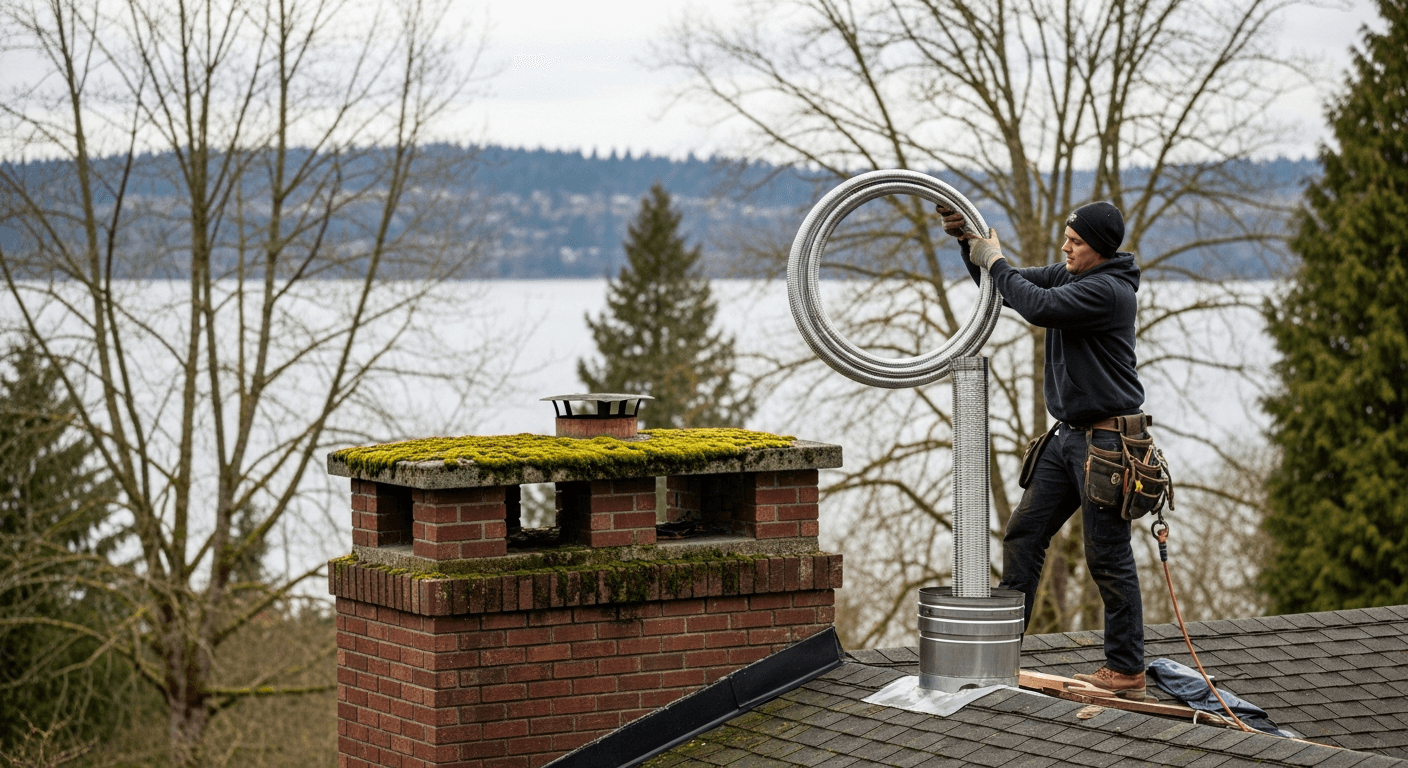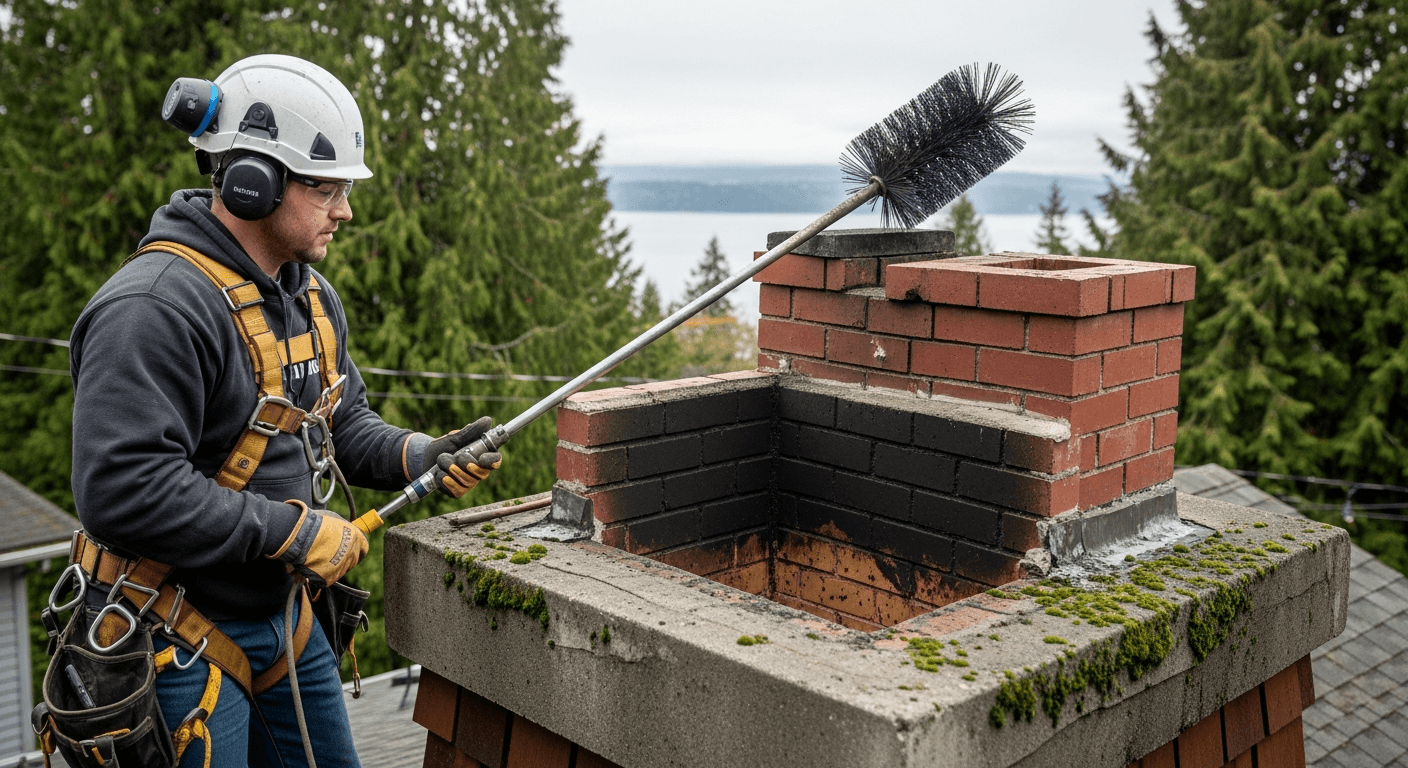
Creosote is the leading cause of chimney fires in Kirkland — and it costs $150 to $800+ to remove depending on how far it has progressed. Kirkland homeowners accumulate creosote faster than most because our wet winters along the Lake Washington corridor make it nearly impossible to burn fully dry wood from October through March. If you burn wood even occasionally, you have creosote, it needs to come out before each burn season, and ignoring it puts your home at genuine risk of a fire that burns at over 2,000 degrees Fahrenheit inside your flue walls.
What Exactly Is Creosote and Why Does Kirkland's Climate Make It Worse?
Creosote is the dark, tar-like residue left behind every time wood burns. It forms when smoke, unburned gases, and wood particles cool and condense on the inside walls of your flue. The cooler the flue gases, the faster creosote sticks — which is the core problem here.
Kirkland's wet winters mean firewood stored outdoors routinely retains 25 to 35 percent moisture even when it looks and feels seasoned. The threshold that matters is 20 percent: wood above that mark burns cooler, produces thicker, wetter smoke, and drives flue temperatures down into the range where condensation — and creosote — accumulates rapidly. That condition persists across much of our burn season.
Older craftsman and mid-century homes near Juanita and Finn Hill frequently have shorter, wider masonry flues built for open-hearth burning habits from a different era. Shorter flues draft less aggressively, slowing gas flow and giving smoke more time to cool and condense before it exits. Even a correctly installed gas insert can produce a light oily film if the unit is out of tune, though heavy creosote is almost entirely a wood-burning concern.
The Puget Sound Clean Air Agency's burn ban schedule also shapes how Kirkland residents use their fireplaces. Many homeowners burn on every approved night, then stop entirely on restricted days. Repeated cold starts — lighting a fire in a flue that has cooled completely since the last burn — cool the liner quickly and accelerate creosote layering compared to sustained, longer burns on the same volume of wood.
The Three Stages of Creosote — and Why Stage 3 Is a Chimney Emergency
Chimney professionals classify creosote in three stages. The stage determines both the fire risk and the cost and difficulty of removal.
Stage 1 is a light, flaky, dusty deposit that brushes off the flue walls with standard wire brushes. It is what a routine annual sweep is designed to clear. Homeowners who clean every year and burn reasonably dry wood typically see nothing worse than Stage 1. Removal is included in a standard sweep costing $150 to $250 in the Kirkland area.
Stage 2 creosote is a harder, tar-like coating — shiny, dark, and sometimes described as resembling dried paint or black lacquer. It has bonded to the flue tile surface and requires rotary cleaning tools and additional labor to break free. Addressing Stage 2 buildup typically adds $100 to $200 to the cost of a standard sweep, putting the total in the $250 to $450 range depending on flue length and deposit thickness.
Stage 3 is the one that turns a cleaning appointment into a multi-visit project. This is dense, hardened, glazed creosote — visually close to a coating of black glass — that has concentrated over multiple burn seasons without removal. It is highly flammable, can meaningfully restrict the usable diameter of the flue, and in serious cases creates enough restriction to push carbon monoxide back into the living space. Removal requires chemical treatments to fracture the glaze, followed by rotary power equipment on a second visit, and a post-cleaning camera inspection to assess whether the liner sustained heat damage. Cost starts around $500 and commonly reaches $800 or more. When Stage 3 buildup has triggered even a partial ignition event, liner damage is frequently discovered afterward — and that moves the conversation directly into relining.
The numbers behind the risk: a creosote fire inside the flue burns at temperatures exceeding 2,000 degrees Fahrenheit. A clay tile liner that was structurally intact before that event is often cracked or spalled afterward. Relining a standard Kirkland chimney flue runs $2,500 to $5,000. Removing creosote before it ignites is always the less expensive outcome by a wide margin.
What Creosote Removal Costs in Kirkland — A Realistic Price Breakdown
The table below reflects realistic pricing for creosote removal and related services in the Kirkland area. Final cost depends on creosote stage, flue height and diameter, and whether any repair or follow-up work is identified during the visit.
One pattern worth flagging: quotes under $99 flat for a chimney sweep are a red flag in this trade. Thoroughly cleaning a flue with meaningful creosote buildup takes time, professional rotary equipment, and a camera to confirm the result. A price that low almost always means an inspection-only visit followed by high-pressure upsell conversations — a pattern some Kirkland homeowners have encountered and reported. Before booking any appointment, ask specifically what tools will be used, whether the quote covers all cleaning labor or only an inspection, and what happens if heavier buildup is found during the visit.
| Service | Creosote Stage | Typical Kirkland Cost | Notes |
|---|---|---|---|
| Standard chimney sweep + creosote removal | Stage 1 | $150 – $250 | Annual maintenance; brush cleaning included in appointment |
| Heavy creosote cleaning | Stage 2 | $250 – $450 | Rotary tools required; adds 1–2 hours to standard visit |
| Glazed creosote removal (chemical + mechanical) | Stage 3 | $500 – $800+ | Two visits typical; liner camera inspection recommended after |
| Chemical creosote treatment (between cleanings) | Stage 1–2 | $75 – $150 | Powder or spray applied to soften future buildup; not a substitute for sweeping |
| Post-cleaning Level 1 camera inspection | Any | $100 – $175 | Confirms liner integrity after Stage 2 or Stage 3 removal |
| Emergency inspection after a creosote fire event | Stage 3+ | $200 – $350 | Required before resuming use; liner damage may require relining |
A Real Kirkland Homeowner Situation: When a 'Quick Sweep' Turned Into a Stage 3 Discovery
A homeowner in the Juanita neighborhood called us last February after noticing a persistent campfire smell inside the house even when the fireplace had not been used in days. They had purchased the home three years earlier and had no chimney maintenance records from the previous owners.
The exterior inspection was unremarkable: the cap was intact, the crown had minor moss growth typical for that part of Kirkland, and there was no visible cracking in the masonry. But the camera told a different story. Starting about four feet up from the firebox and continuing through most of the 22-foot flue, we found a dense, glossy Stage 3 coating that had reduced the effective flue diameter by close to 40 percent.
The smell was creosote off-gassing during mild afternoons — a sign the deposits were thick enough to volatilize at room temperature without any fire burning. We applied a two-part chemical treatment designed to fracture glazed deposits, returned eight days later to run the rotary power equipment once the glaze had partially broken down, then did a post-cleaning camera pass to confirm liner condition. The liner was structurally intact. Catching it before any ignition event made that outcome possible. Total cost was $740. Had a creosote fire occurred first, relining would have been the next conversation.
That homeowner now books an annual sweep every September, sources kiln-dried firewood from a retailer in the Totem Lake area, and has had no further buildup concerns. That is exactly what consistent annual maintenance is designed to produce.
How to Slow Creosote Buildup Between Cleanings — Practical Kirkland Advice
You cannot eliminate creosote — it is a byproduct of combustion — but you can significantly slow the rate at which it accumulates. In a climate like Kirkland's, that matters.
Burn dry wood. This is the single largest variable under your control. In the Pacific Northwest, seasoning firewood outdoors means buying it at least six months before your first fire of the season and storing it with a cover over the top but open sides for airflow. A better option for many Eastside homeowners is kiln-dried firewood, which is available from several retailers in the Kirkland and Totem Lake area, lights faster, burns hotter, and produces far less creosote. A $20 moisture meter takes the guesswork out of it — you want wood reading under 20 percent before it goes into the firebox.
Burn hot fires. A short, smoldering fire is the worst thing you can do to your flue. Low-temperature combustion produces the thickest, wettest smoke. Open the damper fully before lighting, let the fire establish with good airflow, and aim for full two-to-three-hour burns rather than repeated short ones. A hot, well-established fire keeps flue gas temperatures high enough to reduce condensation significantly.
Use a creosote-reducing additive between professional cleanings. These come as powders sprinkled on a burning log or as treated fireplace logs. They do not remove existing buildup, but used regularly they can meaningfully slow Stage 1 and early Stage 2 accumulation. We apply a professional-grade version at the end of most sweep appointments as a standard step.
Schedule your annual sweep in September or early October, before burn season begins. By the end of a Kirkland winter your flue has already done most of its work for the year. Cleaning in fall means you start every burn season with a clear flue and documented knowledge of its condition before the first fire is lit — not after months of additional buildup.
Will Homeowners Insurance Cover Creosote Damage or a Chimney Fire?
This is one of the most common questions we hear from Kirkland homeowners, and the honest answer is that it depends on your specific policy and whether you can demonstrate the chimney was maintained.
Most standard homeowners insurance policies cover sudden, accidental fire damage — including damage caused by a chimney fire — provided the insurer does not determine the loss resulted from neglect. That distinction is where claims run into trouble. If an adjuster finds evidence of heavy, long-standing creosote buildup with no maintenance records, a partial denial or coverage reduction is a real possibility under Washington policies.
Annual sweep receipts are documentation that you were not negligent. That is a practical, non-safety reason to keep service records from every chimney appointment. Some Washington insurers also request proof of chimney maintenance or condition as part of the underwriting process for homes built before 1980 — a category that includes a significant portion of Kirkland's housing stock near Juanita and Finn Hill.
Slow deterioration from years of unaddressed buildup — a gradually cracking liner, for example — is typically classified as a maintenance issue rather than a sudden loss. Most policies do not cover maintenance failures. The pattern holds: dramatic, acute chimney fire events are more likely to receive coverage; slow decay from deferred cleaning is not.
If you have experienced any chimney event — even a brief flare-up you are uncertain about — get a professional inspection before filing a claim and before using the fireplace again. Knowing the actual condition of the liner puts you in a far stronger position when discussing the incident with your insurance carrier.
Frequently asked questions
How often does a Kirkland chimney need to be cleaned?
Once a year is the minimum for any wood-burning fireplace or insert — guidance from the National Fire Protection Association's NFPA 211 standard. In Kirkland, where wet winters make burning fully dry wood a consistent challenge, annual cleaning before burn season is especially important. If you regularly burn more than two cords per season or have had Stage 2 buildup identified in the past, twice a year is appropriate.
How much should a chimney sweep cost in Kirkland, WA?
A legitimate chimney sweep with Stage 1 creosote removal runs $150 to $250 in the Kirkland area. Stage 2 buildup adds rotary cleaning labor, typically bringing the total to $250 to $450. Quotes under $99 are a red flag — that price point rarely reflects a complete cleaning and often means an inspection-only visit with upsells to follow.
What does chimney repair cost after a creosote fire?
Relining a Kirkland chimney flue damaged by a creosote fire typically costs $2,500 to $5,000 depending on flue length and liner material — stainless steel flex liner versus cast-in-place. Firebox repairs for heat damage run $300 to $800 separately. An annual sweep at $150 to $250 is dramatically less expensive than any of those outcomes.
Can I remove creosote myself with a product from the hardware store?
Chemical creosote logs and powder additives can help soften light Stage 1 deposits between professional cleanings, and we use a professional-grade version at the end of our own sweep appointments. But they do not mechanically remove existing buildup, and they have no meaningful effect on Stage 2 or Stage 3 deposits. A camera inspection is also the only reliable way to determine which stage you are dealing with — there is no way to assess that from the firebox opening.
What does a chimney fire look, sound, and smell like?
A creosote fire in the flue typically produces a deep rumbling or roaring sound — often compared to a low jet engine — coming from the chimney. You may see dense black or dark grey smoke from the chimney top, feel intense heat radiating from the fireplace surround or the chase on exterior walls, or notice a sharp, acrid burning smell unlike a normal wood fire. If you suspect a chimney fire: close the damper and glass fireplace doors to limit oxygen, get everyone out of the home, and call 911. Do not use the fireplace again until a professional camera inspection confirms the liner is structurally intact.
Related services