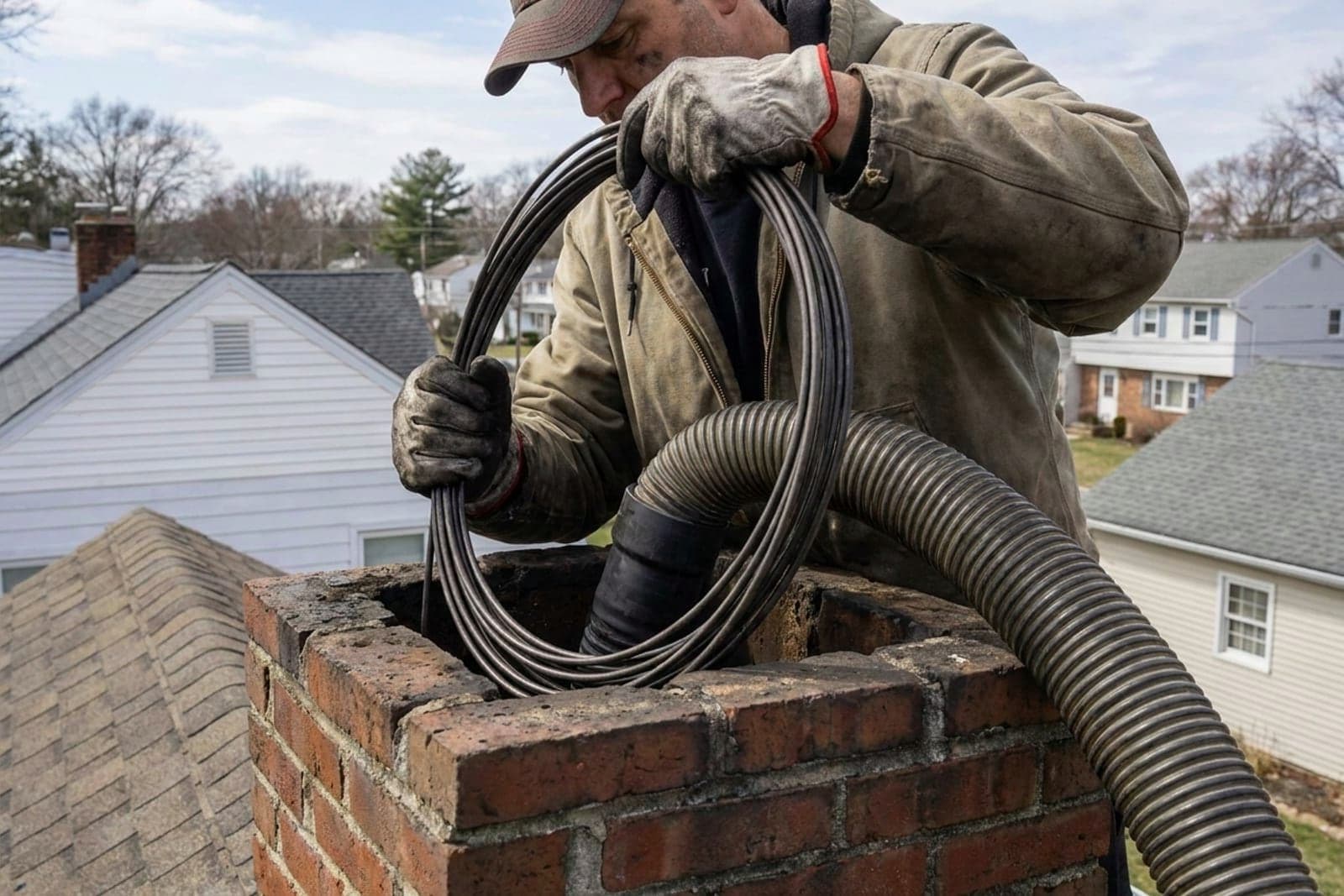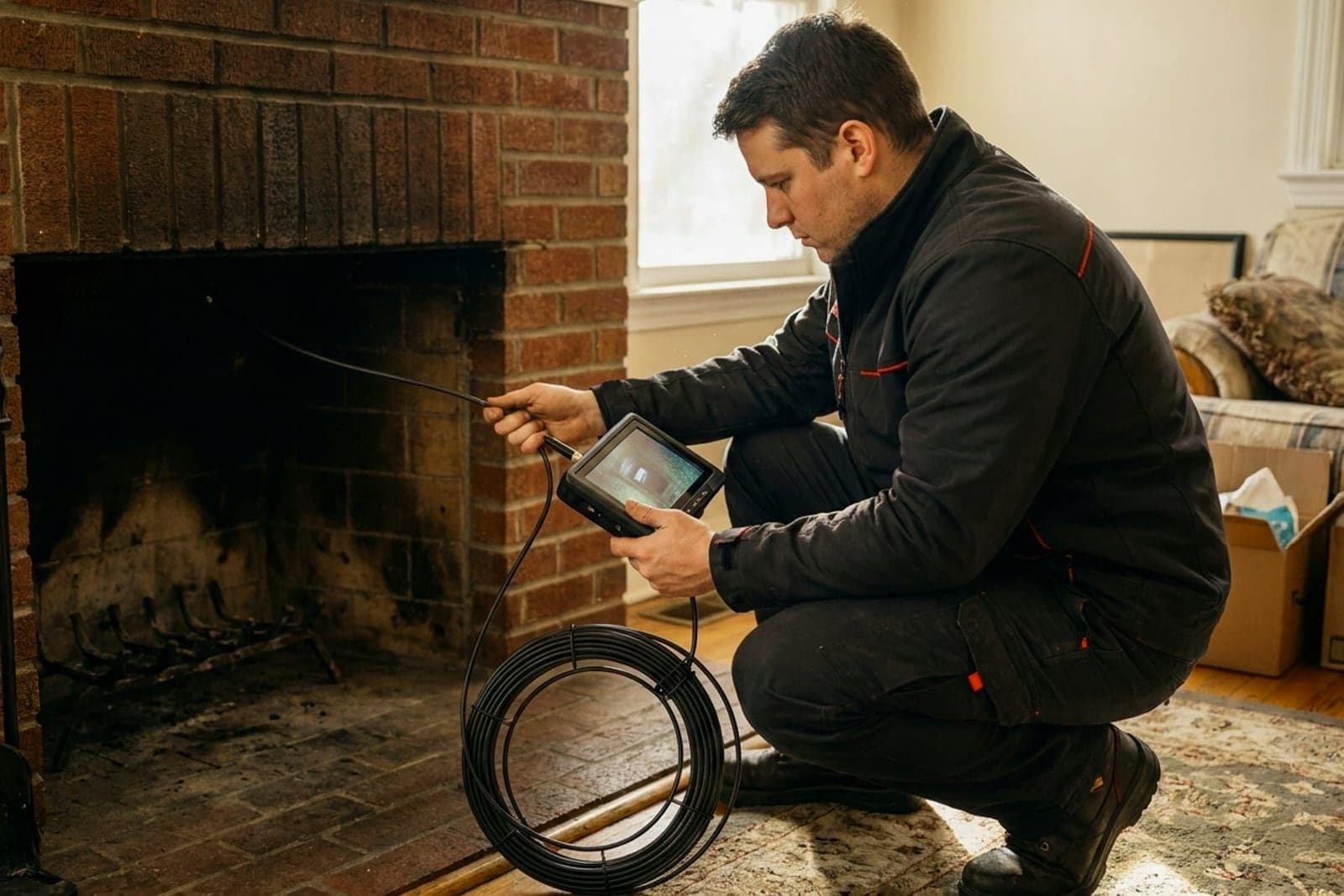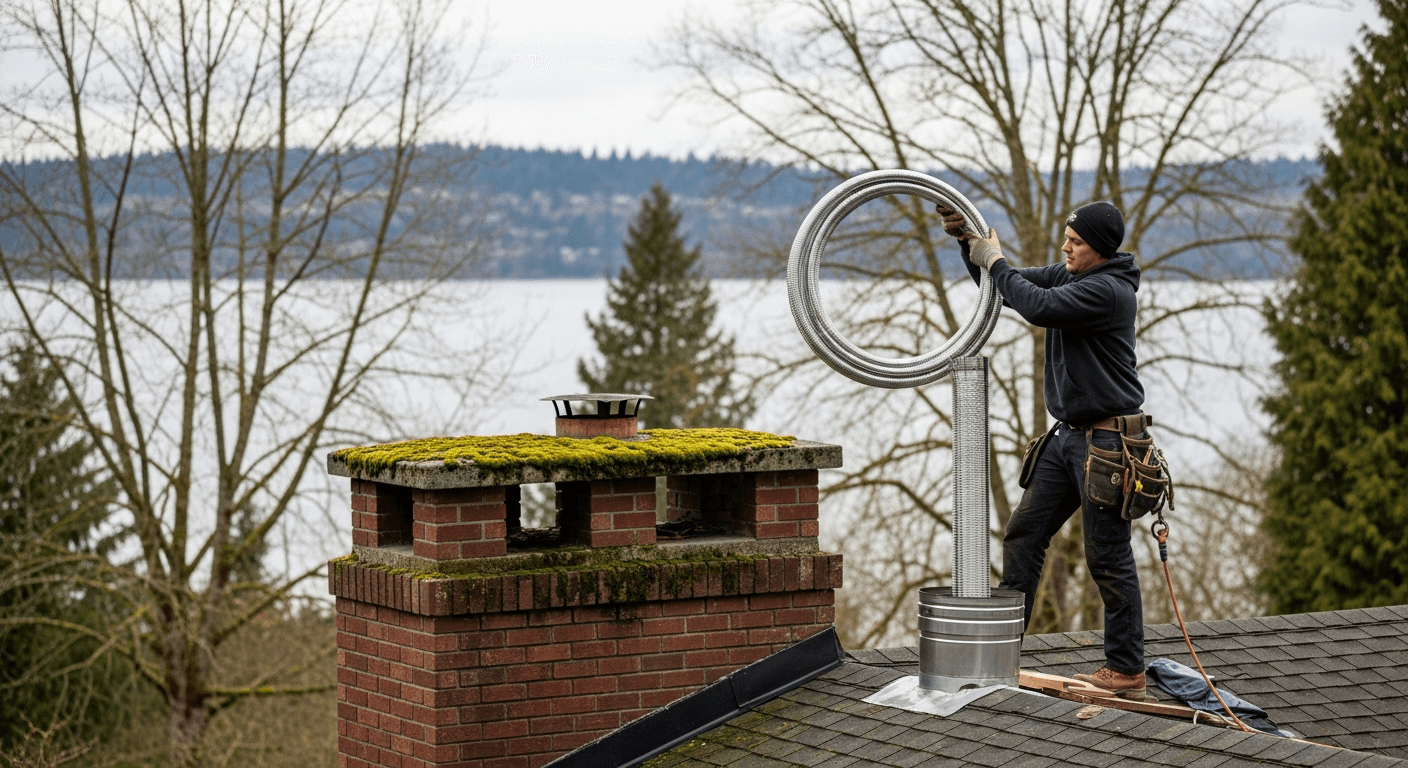
Yes — if your chimney liner is cracked, deteriorated, or missing, relining is not optional; it is the single repair most directly tied to house-fire and carbon-monoxide risk in Kirkland homes. Installed costs in the Kirkland area run from roughly $900 for a stainless-steel liner on a short gas-insert flue to $5,500 or more for a full cast-in-place liner on a structurally compromised masonry chimney. Kirkland's wet winters are the accelerant: moisture enters hairline cracks in clay tile, freezes during the hard freezes that arrive between November and February, and widens those cracks season after season — so a liner that looked marginal in April can be genuinely dangerous before the rains return in October.
What a Chimney Liner Actually Does — and Why Kirkland Homes Need One
The liner is the inner sleeve running from your firebox throat to the chimney cap. It does three things: contains combustion gases so they vent safely out of the home, shields surrounding masonry and framing from corrosive byproducts of combustion, and sizes the flue correctly so your appliance drafts efficiently. When that sleeve fails, superheated gases and creosote contact brick and wood framing directly — the mechanism behind most chimney fires.
A large share of Kirkland homes built between the 1950s and 1990s were lined with clay tile. Those tiles performed well when installed, but decades of Puget Sound freeze-thaw cycling — combined with condensation from high-efficiency furnaces venting into oversized old flues — have left many of them spalled, offset, or fractured. Homes built or fully renovated after 2000 often have stainless steel liners already, but even those require periodic inspection to confirm connections and caps remain intact.
Gas-insert conversions are common throughout Kirkland neighborhoods where Puget Sound Clean Air Agency wood-burning restrictions on Spare the Air days have pushed owners toward gas. Almost every conversion requires a liner retrofit or resize: the original flue sized for a wood fire is far too large for the lower flue-gas temperatures a gas appliance produces. That oversized void causes combustion gases to cool, condense, and partially backdraft — delivering carbon monoxide into the living space and accelerating liner deterioration simultaneously.
The Four Main Liner Options: Costs and When Each Makes Sense in Kirkland
Stainless steel flexible liner systems are the most common choice we install in Kirkland. A flexible liner navigates the crooked or offset flues common in older Craftsman and mid-century homes in Juanita, Bridle Trails, and the Lakeview neighborhood — places where chimneys were not always built plumb. Most product lines carry a manufacturer lifetime warranty, and stainless handles both gas-insert retrofits and wood-burning appliances. It is the default recommendation when the surrounding masonry is structurally sound.
Cast-in-place liners are the right answer when masonry has deteriorated beyond what a steel liner can address alone. A technician inflates a bladder inside the flue, pumps lightweight castable cement around it, then deflates and removes the bladder after curing. The result is a seamless, insulated liner bonded to the existing brick — capable of rehabilitating a chimney that would otherwise require demolition. It is more labor-intensive and costs more, but it carries the longest service life of any option.
Aluminum flexible liner is approved only for Category I gas appliances — natural-gas furnaces or boilers producing cool, non-condensing flue gases. It is never appropriate for wood-burning or gas fireplaces, which generate higher flue temperatures. Aluminum costs less upfront but has a significantly shorter service life than stainless; we present that trade-off directly so homeowners can make an informed choice for their budget and timeline.
HeatShield ceramic repair is not a full reline but belongs in this conversation. When a clay tile liner has isolated cracks in an otherwise structurally sound flue, a technician applies a brushed-on resurfacing compound that seals cracking and restores smooth interior surfaces without removing the tile. It costs less than a full liner and extends the original liner's service life meaningfully — but it is only appropriate when the majority of the tile is intact. Camera footage determines eligibility.
The table below reflects realistic installed prices for Kirkland-area jobs in 2024. Flue height (most Kirkland chimneys run 15 to 28 feet), number of offsets, liner diameter, and whether the smoke chamber or damper must be addressed before liner insertion all affect where a job lands within its range.
| Liner Type | Best For | Typical Installed Cost (Kirkland, 2024) | Expected Lifespan |
|---|---|---|---|
| Stainless steel flexible — gas insert retrofit | Gas inserts, gas fireplaces | $900 – $1,800 | 25–30 years with annual inspection |
| Stainless steel flexible — wood-burning | Wood stoves, open wood-burning fireplaces | $1,500 – $3,200 | 20–25 years |
| Aluminum flexible | Category I gas appliances only (not fireplaces) | $700 – $1,100 | 10–15 years |
| Cast-in-place / poured liner | Structurally compromised masonry, multiple offsets | $2,800 – $5,500+ | 50+ years |
| HeatShield ceramic repair (partial) | Isolated cracks in otherwise intact clay tile | $900 – $2,400 | Extends original liner life 15–20 years |
How Quickly Does Liner Damage Progress in Kirkland? A Timeline by Situation
Kirkland homeowners often ask whether a marginal liner can wait until next season. The answer depends heavily on the specific situation — appliance type, existing liner condition, and how many freeze-thaw cycles remain in the season. The table below summarizes how quickly deterioration typically progresses under common Kirkland conditions, based on the patterns our inspection team documents each year.
The most time-sensitive situations are homes where a high-efficiency gas appliance vents into an unresized clay-tile flue, and homes where camera inspection has already confirmed offset or missing tile sections. In those cases, continued use carries immediate CO and fire risk rather than a gradual maintenance concern. A marginal liner on a wood-burning fireplace used only occasionally presents a different timeline than the same liner on a furnace running daily through a Kirkland winter.
These timelines are illustrative ranges based on typical Kirkland conditions. An annual camera inspection — ideally each September before burn season — is the only way to know exactly where a specific liner stands at a given moment.
A Kirkland Scenario: The Gas Insert Making a Family Feel Foggy Every Evening
A homeowner in Kirkland's Lakeview neighborhood called us in November after noticing that family members felt sluggish and headachy on evenings when they ran the gas insert. A previous owner had converted the original wood-burning fireplace to gas, and because the home had recently sold, the installation history was unknown.
Our Level 2 camera inspection found the original 13-by-13-inch clay tile liner — sized for a wood fire — still in place, with the gas insert's small flex connector simply dumping exhaust into the bottom of that enormous unlined space. There was no dedicated liner at all. Combustion gases were cooling rapidly in the oversized flue, condensing, and backdrafting into the firebox and the living room. A test-burn CO reading in the room exceeded safe thresholds by a wide margin.
We installed a 4-inch stainless steel flexible liner from the insert collar to the chimney cap in a single day. The homeowner ran the insert that evening — strong draft, no odor, and a CO monitor that read zero throughout the night. The total installed cost was just over $1,100. That repair is one of the highest-impact, lowest-cost corrections we make, and it is one of the most common findings on Kirkland homes where gas inserts were added by a previous owner without a proper liner retrofit. This scenario is hypothetical and illustrative of conditions our inspections routinely uncover.
Warning Signs Your Kirkland Chimney May Need Relining Before Next Winter
Camera inspection is the only definitive answer, but several surface signs warrant an immediate call. White staining (efflorescence) on exterior masonry near the chimney crown means moisture is migrating through cracked tiles and leaching minerals outward. Flakes or chunks of clay tile in the firebox — called tile spalls — confirm the liner is actively breaking apart. A persistent smoky smell in a room where the fireplace has not been used, or smoke rollout into the room when you try to start a fire, points to a disrupted draft caused by a compromised liner.
If your home is among the many Kirkland properties where a high-efficiency gas furnace replaced an oil furnace in the last two decades, and that appliance was vented into the original clay-tile chimney without relining, there is a condensation problem developing whether visible symptoms have appeared yet or not. High-efficiency appliances produce acidic condensate in large volumes inside an oversized flue; clay tile can deteriorate noticeably within five to seven years of that exposure.
Kirkland's gray, damp winters — with hard freezes recurring from November through February — accelerate every mode of liner damage. Our most severe liner failures consistently show up in late-winter and early-spring inspections after a full season of freeze-thaw cycling has done its work. If you plan to burn through next winter, schedule your inspection in September or October — early enough that any relining can be completed before the rainy season locks in.
Does Homeowners Insurance Cover Chimney Relining in Kirkland?
Coverage depends entirely on the cause of damage. Standard homeowners policies cover sudden, accidental losses — so if a chimney fire cracked your liner, or a windstorm toppled debris that damaged the flue, your insurer may reimburse repair or replacement minus your deductible. Photograph everything and contact your agent before any repair work begins; starting repairs without documentation can complicate a claim.
What policies almost never cover is deterioration from age, freeze-thaw cycling, or deferred maintenance — which describes the majority of liner failures we document in Kirkland. Insurers classify gradual wear as a homeowner-maintenance responsibility. A few premium policy riders include limited chimney-repair language, so a ten-minute call to your agent is worth making before you assume coverage is unavailable.
For buyers and sellers in Kirkland's Eastside market, a failed liner discovered during a pre-purchase Level 2 inspection is a transaction event. It gives a buyer documented leverage to negotiate repair credit and gives a seller the opportunity to correct a known liability before it derails closing. We handle a steady volume of pre-purchase inspection calls in neighborhoods like Bridle Trails, Juanita, and South Kirkland, where homes built in the 1960s through 1980s change hands regularly and original clay-tile liners are the norm.
Frequently asked questions
How do I know if my liner needs full replacement versus a partial repair?
A Level 2 camera inspection is the only reliable way to determine whether a Kirkland chimney liner needs full replacement or a partial repair. If isolated cracks appear in an otherwise structurally intact clay tile liner, a HeatShield resurfacing repair costing $900–$2,400 may be sufficient. Extensive spalling, offset tile sections, or any missing liner segment requires full relining. We show you the camera footage so you see exactly what we see before we recommend anything.
How long does chimney relining take?
Most stainless steel flexible liner installations in Kirkland take four to eight hours and are complete in a single day — your appliance is usable that evening. Cast-in-place jobs require the castable cement to cure for 24 to 48 hours before the appliance can be operated. We provide a specific timeline at the time of estimate based on your flue height and configuration.
Can I keep using my fireplace or gas insert while waiting for liner repair?
If a Level 2 inspection has confirmed a seriously deteriorated or missing liner in a Kirkland chimney, we recommend against operating the appliance until repairs are complete. Carbon monoxide intrusion and chimney fire risk are both real. If the inspection shows only minor documented cracking and the inspector confirms the appliance remains operable in the interim, we will say so explicitly — but do not assume it is safe to continue without asking us directly.
Does my gas insert in Kirkland definitely need its own dedicated liner?
In almost every case, yes — a gas insert in a Kirkland home needs its own dedicated liner. Gas inserts require a properly sized dedicated liner — typically 4 or 6 inches in diameter — running from the insert collar to the chimney cap. Using the original oversized clay-tile flue built for a wood fire creates dangerous condensation and backdraft conditions. This is among the most common safety deficiencies we find during inspections of Kirkland homes where gas inserts were installed by previous owners.
What makes Kirkland's climate especially hard on chimney liners?
Kirkland's combination of high annual rainfall, persistent humidity, and recurring hard freezes between November and February creates aggressive freeze-thaw cycling inside clay tile flues. Water enters hairline cracks in the liner, freezes, expands, and widens those cracks each cycle. After several Kirkland winters, a liner that was marginal can become a genuine fire or CO hazard. Annual inspection — ideally each September before burn season — catches deterioration before it reaches that point.
Related services