A Level 2 chimney inspection is a video-camera examination of your chimney's full flue length, liner condition, and accessible structural areas — and in Kirkland it typically costs $200 to $450. Washington State's wet winters accelerate creosote buildup and freeze-thaw liner damage in ways that a standard visual check cannot detect, which is why a Level 2 is required for home sales, fuel-type changes, post-fire clearance, and storm-damage assessments throughout the Eastside.
What are the three levels of chimney inspection — and what makes Level 2 different?
NFPA 211 defines three inspection tiers. The level required depends on what has changed in or around your chimney system since the last inspection.
A Level 1 inspection is the annual check that accompanies a routine chimney sweep. Your technician visually examines all readily accessible portions of the firebox, smoke chamber, and exterior chimney — no camera, no attic entry. It confirms the basic structure is sound and the flue is clear. It is appropriate when nothing has changed: same fuel, same appliance, no known events.
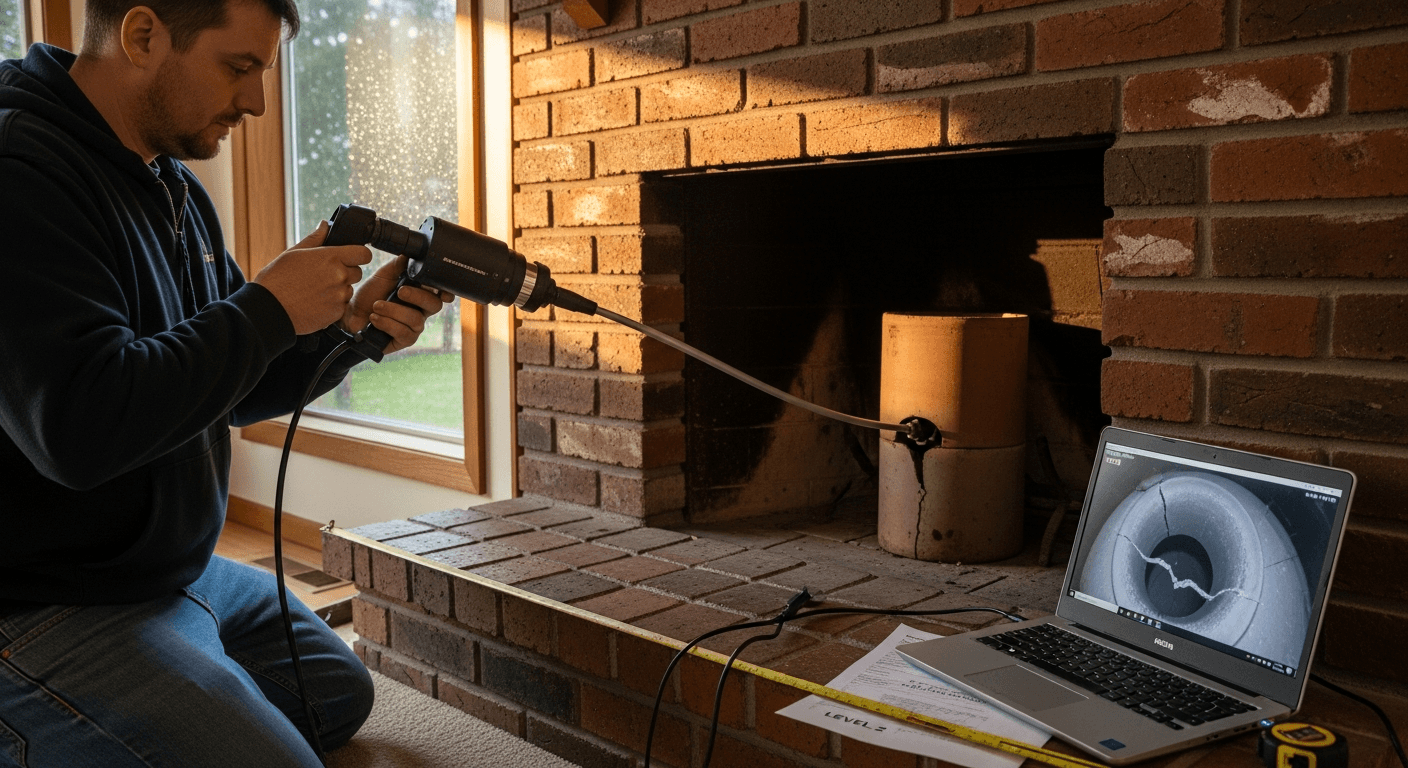
A Level 2 inspection adds a video camera scan of the flue's full length — from the firebox throat to the chimney cap — and includes examination of accessible attic, crawlspace, and basement sections where the chimney passes through the home. This is the standard that real-estate transactions and insurance carriers require because it produces documented evidence of liner condition that a Level 1 cannot provide.
A Level 3 inspection is invasive, involving removal of chimney components to access concealed areas. It is ordered only when a Level 2 reveals damage that cannot be fully diagnosed otherwise — typically after a severe chimney fire that cracked a liner behind intact masonry.
The practical difference for Kirkland homeowners: a Level 2 produces a written report with shareable video footage. That documentation is what gives the inspection its value for buyers, sellers, insurers, and contractors.
When does a Kirkland homeowner actually need a Level 2 inspection?
Real-estate transactions are the most common trigger. Whether you are listing a 1970s craftsman near Juanita Beach or purchasing an established home in the Bridle Trails neighborhood, your agent or the buyer's agent will almost certainly request a Level 2 report. Many lenders require documented liner condition before closing, and home inspectors who flag a fireplace as 'unable to evaluate' routinely recommend a Level 2 as the necessary follow-up.
Installing a gas insert or wood stove into an existing masonry fireplace is the second most common reason. Switching fuel type or appliance changes the thermal output, moisture load, and flue-size requirements inside the liner. A Level 2 confirms the existing liner can safely handle the new system before installation begins — and is required by most gas-insert manufacturers to preserve their warranty.
Any chimney fire requires a Level 2 before the fireplace is used again. Creosote ignites at roughly 1,100°F and can crack clay tile liners even in a brief, low-intensity event. Kirkland's damp winters — averaging over 37 inches of annual rainfall — promote the heavy Stage 2 and Stage 3 creosote deposits that fuel these fires, making post-fire inspections a genuine local need rather than a theoretical one.
Significant weather events are a valid fourth trigger. The Eastside sees periodic high-wind events that can topple chimney caps, displace crown mortar, and shift flashing, allowing water to enter the liner. A draft change, unfamiliar smell, or debris in the firebox after a storm warrants a Level 2 to confirm liner integrity.
Puget Sound Clean Air Agency wood-burning restrictions remind Kirkland homeowners that legal burn days require a fully operational, clean system. Scheduling a Level 2 before burn season — typically before October — ensures you are ready when those permitted days arrive.
What does a Level 2 chimney inspection cost in Kirkland — and what drives the price?
Most Kirkland homeowners pay $200 to $450 for a standalone Level 2 inspection. The range reflects real differences in time and equipment required for each job.
Chimney height is the largest variable. A single-story rancher near Totem Lake has a shorter flue run — often 12 to 15 feet — than a two-story home on the hillside above downtown Kirkland, where flues can exceed 25 feet. Longer flue runs require more camera cable management and add 20 to 40 minutes to the inspection. Multi-flue or offset-flue chimneys take longer than straight single-flue systems.
Bundling with a Level 1 sweep affects the total but usually saves money compared to booking separately. If the flue is heavily soiled with creosote, the technician will sweep before running the camera — otherwise the lens cannot read the liner clearly — and that cleaning is billed in addition to the inspection fee.
A written report with video footage is non-negotiable for a legitimate Level 2. If a quote does not explicitly include video documentation, ask before booking. Without recorded footage, the inspection carries no weight with a buyer's agent, lender, or insurance adjuster.
Rush scheduling — standard when a closing date is two to three weeks out — typically adds $50 to $100 to the base rate.
| Service | Typical Cost in Kirkland WA | What's Included |
|---|---|---|
| Level 1 Inspection (with sweep) | $150–$250 | Visual check of all accessible areas, flue sweep, basic written condition report |
| Level 2 Inspection (standalone) | $200–$450 | Full-length video camera scan of flue, written report with footage, attic/crawlspace check where accessible |
| Level 2 + Level 1 Sweep (bundled) | $300–$550 | Complete flue sweep plus camera inspection, single combined written report with video |
| Level 3 Inspection | $600–$1,200+ | Structural component removal to access concealed damage; ordered only when Level 2 finds inconclusive results |
| Rush/same-week scheduling premium | $50–$100 added | Priority dispatch for active real-estate closings or post-fire urgent assessments |
A real scenario: the Kirkland home sale that almost fell through
A homeowner in the Norkirk neighborhood listed their 1978 split-level in early March. The family had burned wood through every winter for years and had no reason to suspect a problem. During the general home inspection, the inspector noted the fireplace was 'unable to evaluate' and flagged it for specialist review.
Kirkland Chimney Pros scheduled a Level 2 inspection within three days. The camera revealed two findings invisible from the firebox opening or the roofline: a 14-inch section of clay tile liner had separated near the roofline — consistent with Kirkland's repeated late-winter freeze-thaw cycles acting on an aging mortar joint — and Stage 2 creosote coated the lower third of the flue, a signature of slow-burning fires in a partially blocked system.
The written report and timestamped video gave the sellers documented evidence to negotiate a targeted repair credit rather than a blanket price reduction. Kirkland Chimney Pros relined the damaged section and cleared the creosote. The transaction closed on the original date. The sellers later said they would have scheduled the Level 2 before listing had they understood what the camera could find that a visual check cannot — the three-day scramble mid-contract was entirely avoidable.
How to prepare for your inspection and get the most useful report
Do not use the fireplace for at least 24 hours before the inspection. A cool firebox is safer for the technician and prevents camera-lens fogging from residual heat.
Clear the hearth area completely. Remove tools, decorative items, rugs, and nearby furniture. Your technician needs unobstructed access to the firebox and may need to route camera cable across the room.
Compile your fireplace history before the appointment. Records of past sweeps, any repair work, unusual smells, draft changes after windstorms, or sounds from the chimney during heavy rain all help the technician prioritize where to look closely on the camera feed.
Request video footage in a shareable digital format. A video file you can email to a buyer's agent, lender, or insurance adjuster is far more useful than a printed still image. Kirkland Chimney Pros provides this as standard.
If the report identifies a defect, ask immediately about repair timeline and material lead time. Some liner repairs — like a partial reline of a separated tile section — can be completed within a week. Others requiring specialty liner materials may need two to three weeks. Knowing the timeline before your closing date or insurance renewal prevents last-minute delays.
Frequently asked questions
How often does a chimney need to be inspected in Kirkland?
NFPA 211 recommends a Level 1 inspection every year for any chimney in regular use. For Kirkland homeowners burning wood through a typical wet winter, annual is the right cadence. A Level 2 is required on top of that whenever something changes — a home sale, a new appliance, a chimney fire, or damage from a weather event.
Will homeowners insurance cover a Level 2 chimney inspection?
Routine inspections are considered maintenance and are not covered by standard homeowners policies. However, if a Level 2 uncovers damage caused by a covered event — a windstorm that displaced the crown, or a chimney fire — the repair costs may be claimable. The Level 2 written report and video footage are precisely what your insurer will require to process that claim.
What does a Level 2 chimney inspection cost in Kirkland, WA?
A standalone Level 2 inspection runs $200 to $450 in Kirkland. Bundled with a Level 1 sweep, expect $300 to $550. Chimney height, flue configuration, and whether rush scheduling is needed are the main factors that move the price within those ranges.
How much does a chimney sweep cost in Kirkland?
A standard chimney sweep with a Level 1 inspection runs $150 to $250. Flues with heavy Stage 2 or Stage 3 creosote buildup — common in Kirkland homes that burn wood regularly through damp winters — may require additional cleaning time and push the cost higher. Quotes under $100 typically exclude the inspection component.
Can I skip the Level 2 inspection when buying a home with a fireplace in Kirkland?
You can, but it is a meaningful risk. A general home inspection does not include a camera scan of the flue, so separated liner tiles, cracked mortar joints, and hidden creosote will not appear in that report. In Kirkland's older housing stock — much of it built in the 1960s through 1980s with original clay tile liners — these defects are common enough that a Level 2 is standard due diligence before committing to a home with a working fireplace.
Related services