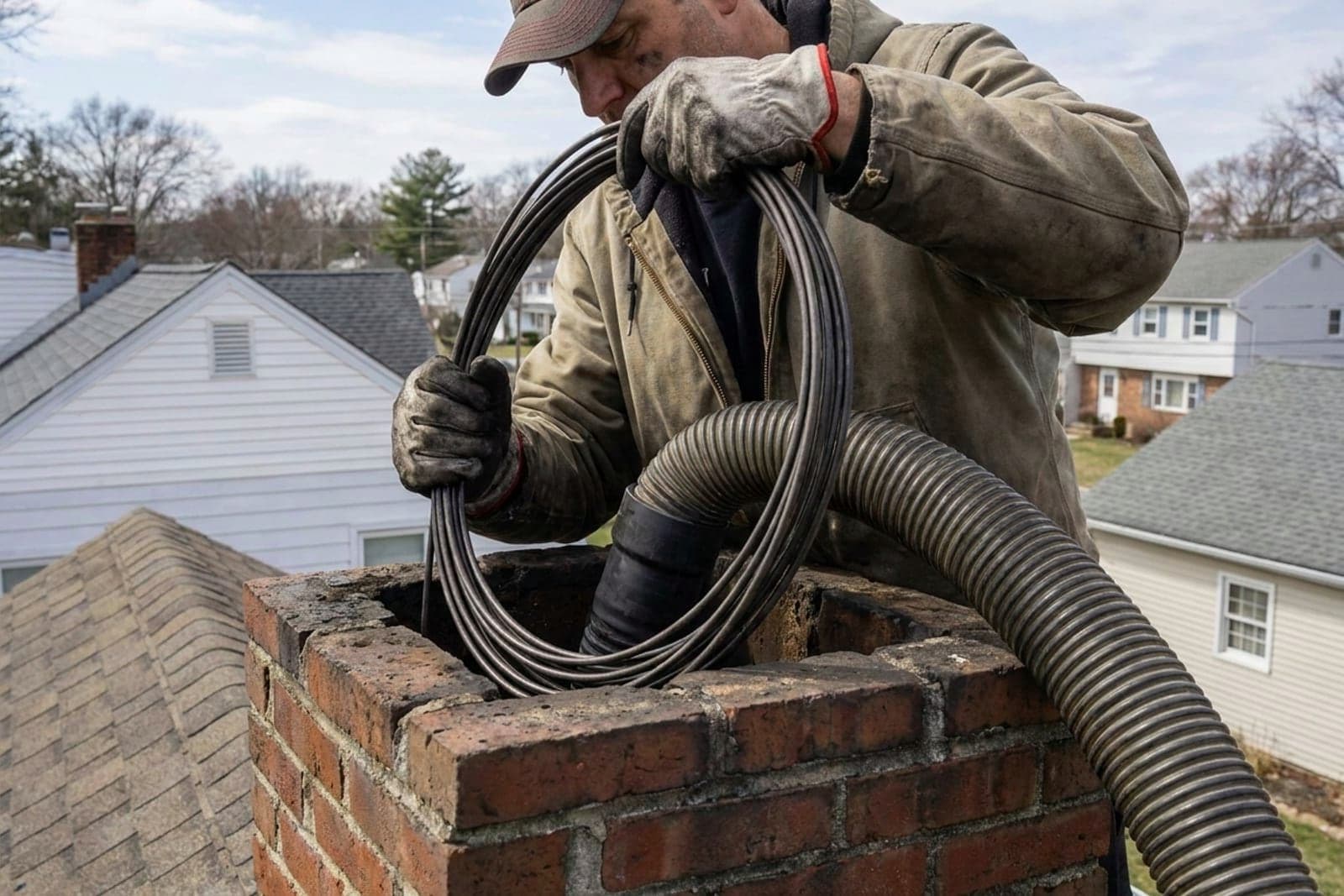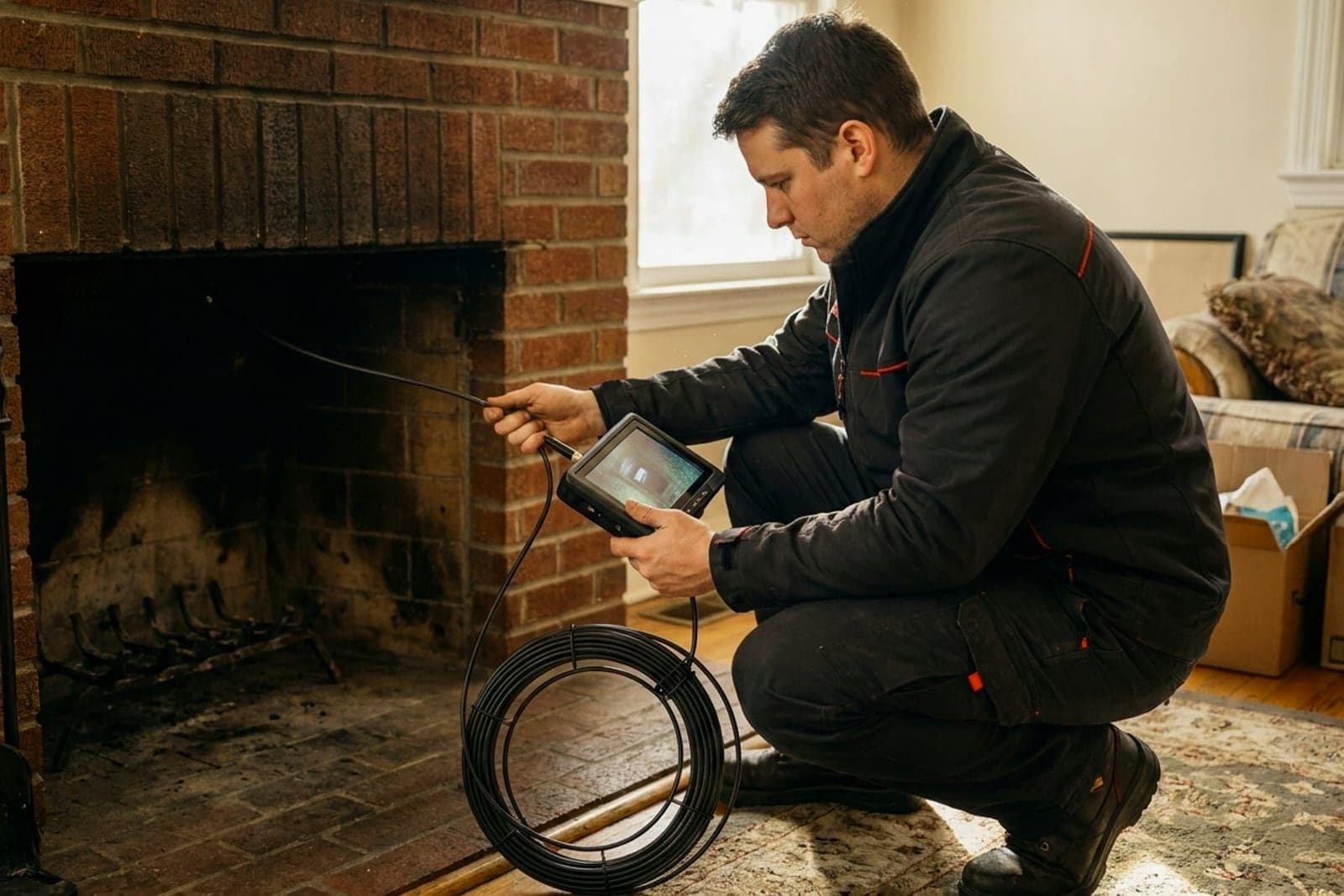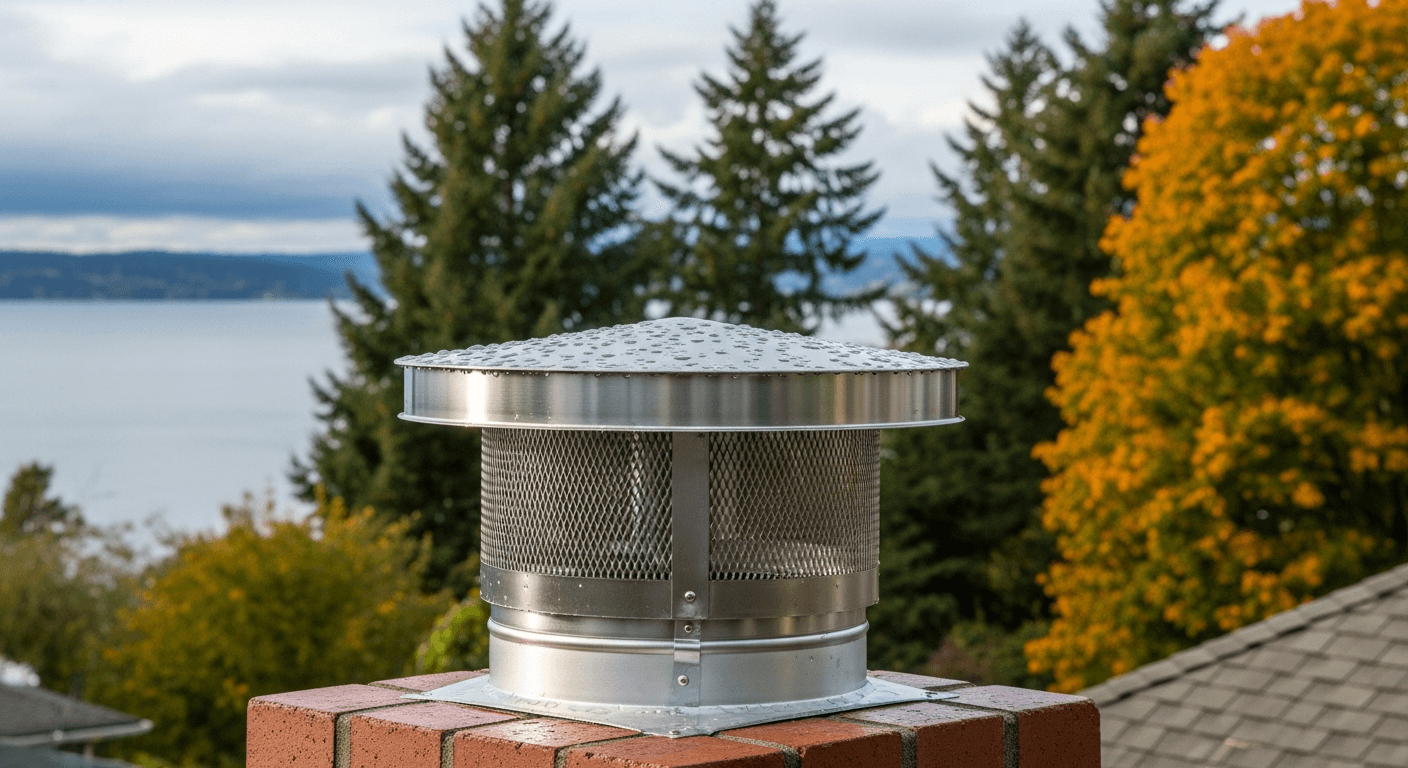
Yes, your Kirkland chimney almost certainly needs a cap — and if it is missing or damaged, replacing it is the single highest-return chimney investment you can make before the October rains arrive. A properly fitted cap blocks rain, nesting animals, wind-driven debris, and downdrafts from a flue that is otherwise a direct opening into your home, and in a city that receives 37 inches of rainfall a year, an unprotected flue is not a minor oversight — it is an active source of structural damage.
What a chimney cap actually does — and why Kirkland's climate makes it essential
A chimney cap is a metal cover fitted directly over the flue tile at the top of the chimney. A solid lid sheds rain and falling debris; a stainless steel mesh skirt lets combustion gases escape while blocking birds, squirrels, and raccoons from entering.
Kirkland's rainfall pattern is the main reason a cap is non-negotiable here. We average 37 inches of rain annually, concentrated in slow, persistent drizzles from October through April — exactly the conditions that drive water deep into an open flue. Every raindrop that reaches an uncapped flue tile soaks the liner, saturates mortar joints, and accelerates deterioration. On older homes in Juanita, Bridle Trails, and along the Market Street corridor, we routinely find chimneys where the absence of a cap turned what would have been a $200 installation into a $3,000 relining project after two or three wet seasons of unchecked moisture intrusion.
Kirkland's dense tree canopy adds a second threat. Leaves, twigs, and moss spores blow off the mature Douglas firs and big-leaf maples that line most residential streets year-round. Moss colonizes unprotected masonry faster than most homeowners expect, and organic debris accumulating inside the flue creates a fire hazard and accelerates liner degradation. Raccoons and European starlings — both abundant across the Eastside — treat an uncapped chimney as a ready-made nesting site. We pull nesting material from flues every spring, and in several cases the blockage was severe enough to force carbon monoxide back into the living space.
Gas-insert owners are not exempt. Moisture intrusion corrodes flex liner and insert components even without creosote present, and some gas-insert manufacturers specifically require a matching termination cap to maintain the draft characteristics their appliance was tested with. If yours was installed without one, that gap may void the appliance warranty.
The main types of chimney caps and how to choose the right one for your home
Single-flue caps attach directly to the flue tile and are the most common type on Kirkland homes built after 1970. Standard tile sizes run from 8×8 inches to 13×13 inches, so getting the dimensions right before ordering matters. Galvanized steel is the entry-level option, but in Kirkland's damp climate galvanized caps typically rust through in five to eight years. Stainless steel costs roughly $60 to $130 more installed and lasts 20 to 30 years — almost always the better value over any reasonable time horizon.
Multi-flue caps, also called top-mount or outside-mount caps, cover the entire chimney crown rather than individual flue tiles. They are the right choice for older Kirkland homes — particularly the 1950s-through-1970s construction common in Rose Hill, Norkirk, and Finn Hill — that have two or three flues serving a fireplace, a gas furnace, and a water heater. A single multi-flue cap protects every opening simultaneously and also shields the crown masonry from direct rain contact, which is where cracking and spalling typically begin.
Wind-directional caps rotate to face away from the prevailing wind direction and are worth considering on lakefront or west-facing hillside properties in Kirkland where westerly winds off Lake Washington create persistent downdrafts that push smoke back into the house. Standard caps do not solve that problem; a rotating cap often does.
Draft-increasing caps use a venturi profile to accelerate upward airflow. They address a specific problem — chimneys that are marginally short relative to the roofline — which appears on a number of Eastside townhomes and split-levels built in the 1980s where the flue height barely meets Washington State code. If you have recurring smoke spillage into the room that cleaning and damper adjustment have not resolved, this cap style is worth discussing.
Regardless of type, specify stainless steel mesh with openings no larger than five-eighths of an inch. That dimension is the standard called out in Washington State fire code: large enough to vent ash particles freely, small enough to exclude birds, squirrels, and the debris most common in Kirkland's neighborhoods.
What chimney cap installation and replacement costs in Kirkland in 2025
The figures above reflect jobs completed by Kirkland Chimney Pros on Eastside residential properties. Final price depends on cap type, material, flue count, and roof pitch — a steep 8:12 or greater pitch on a two-story home requires additional safety rigging and extends labor time.
Most single-flue stainless cap installations on accessible chimneys are complete in under an hour. Multi-flue and custom-fabricated jobs on older masonry chimneys typically take two to three hours. If the existing cap is rusted solid or cemented to the crown, removal adds $30 to $60 to the labor charge.
A practical note on galvanized: at $120 to $195 installed it looks affordable, but replacing it every six to eight years means spending $360 to $600 over a 24-year period versus $185 to $320 once for stainless. The math favors stainless steel from the first replacement cycle onward.
| Cap Type | Material | Typical Installed Cost (2025) | Expected Lifespan |
|---|---|---|---|
| Single-flue cap | Galvanized steel | $120 – $195 | 5 – 8 years |
| Single-flue cap | Stainless steel | $185 – $320 | 20 – 30 years |
| Single-flue cap | Copper | $340 – $575 | 50+ years |
| Multi-flue / top-mount cap | Stainless steel | $290 – $995 | 20 – 30 years |
| Custom-fabricated cap (non-standard crown) | Stainless steel | $390 – $665 | 20 – 30 years |
| Wind-directional (rotating) cap | Stainless steel | $230 – $400 | 15 – 25 years |
Common cap problems, what causes them, and what Kirkland homeowners typically see first
The table below maps the symptoms Kirkland homeowners most commonly report to their underlying cap-related cause. Because a chimney cap sits at the top of the flue and is rarely visible without binoculars or a roof inspection, the problem is almost always diagnosed from the inside out — a stain, a sound, or a smell is the first clue. Matching that symptom to the likely cause helps you communicate clearly when you call for service and helps you understand whether the repair is urgent.
| Symptom Homeowner Notices | Most Likely Cap-Related Cause | Urgency Level |
|---|---|---|
| Water stain on ceiling or firebox back wall after rain | Cap missing, tilted, or rusted through — flue exposed to rainfall | High — schedule inspection before next rain event |
| Chirping, scratching, or rustling sounds from flue | Mesh damaged or absent — bird or animal nesting inside flue | High — blockage can force carbon monoxide into living space |
| Smoke or downdraft pushing back into the room | Cap absent, wrong style for roof geometry, or mesh clogged with debris | Moderate — fire use should be limited until resolved |
| Orange rust staining running down chimney crown | Galvanized cap corroding — rust streaks indicate cap failure is imminent | Moderate — cap replacement before next wet season |
| Leaves, twigs, or debris accumulating in firebox | Cap mesh torn, missing, or mesh openings oversized | Moderate — debris in flue is a fire hazard |
| Musty or earthy odor from fireplace in summer | Cap missing or damaged — moisture and organic debris have entered flue | Low-to-moderate — inspect before fall burning season |
| Visible moss or vegetation growing on crown masonry | Cap absent or undersized — crown exposed to direct rainfall and organic debris | Low — address before moisture accelerates masonry deterioration |
A Kirkland homeowner scenario: a water stain, a misdiagnosis, and a same-day fix
Consider a hypothetical but common situation: a homeowner in the Juanita neighborhood calls in early November after a dark water stain appears on the ceiling above their living room fireplace. They have already hired a roofer to investigate and been told the roof is sound — no flashing failures, no damaged shingles.
When a technician reaches the chimney crown, the source is immediately apparent. The original galvanized cap — installed when the home was built in the early 1980s — has rusted through along one side and tilted roughly 30 degrees, leaving most of the 9×13-inch flue opening exposed to the sky. The heavy rains that hit Kirkland that October have poured directly down the flue, saturating the smoke shelf and the back wall of the firebox. The ceiling stain is moisture migrating through the masonry and framing.
The failed cap is removed, accumulated debris and standing water are cleared from the smoke shelf, and a stainless steel single-flue cap is installed the same morning. The homeowner runs the damper open with a box fan pulling air through the firebox for three weeks until the masonry dries out. The ceiling stain fades without any additional remediation once the moisture source is gone. Total invoice for the service call and cap: $272. The roofer visit alone cost more than that.
This scenario — fall water stain, assumed roof leak, actual cause a failed cap — repeats itself several times every October and November in Kirkland. A failed or missing cap is the first thing we check during any inspection, because the damage pattern is predictable and the fix, caught early, is straightforward.
When to inspect, replace, or upgrade your chimney cap
August and early September are the optimal window for cap inspection and replacement in Kirkland. Dry conditions make roof work safer, allow any crown sealant to cure fully, and ensure the chimney is sealed before the first sustained rain of the season, which typically arrives in early October.
Replace your cap immediately — regardless of season — if you see rust staining running down the chimney crown, bent or torn mesh, signs of animal entry such as chirping or scratching sounds from the flue, or any water appearing inside the firebox after rainfall.
Between professional visits, inspect your cap visually once a year from the ground using binoculars, or from a second-floor window if your roofline allows a clear sightline. Look for a tilted or displaced cap body, missing mesh panels, and heavy moss or orange rust discoloration on the crown.
If you are planning to convert a wood-burning fireplace to a gas insert — a project that requires relining the flue and reconfiguring the termination point — include a new cap in that scope. The incremental cost during an active liner installation is small, and it ensures the cap and liner are matched correctly from the start.
Frequently asked questions
Can I install a chimney cap myself?
On a single-story Kirkland home with a low-slope roof and a standard flue tile size, a single-flue cap is technically DIY-feasible if you are experienced working at height and measure the flue tile accurately before purchasing. Most Kirkland homes, however, have steep-pitch roofs on two-story structures — conditions where a misstep is serious and an ill-measured cap can blow off or leave gaps. Kirkland Chimney Pros recommends professional installation for any two-story home, any multi-flue chimney, and any job where the crown needs sealant or repair work alongside the cap.
Will a chimney cap restrict my fireplace draft?
A correctly sized chimney cap has no measurable effect on draft under normal conditions. Wind-directional and draft-increasing cap styles can actually improve draft on problem chimneys in the Kirkland area. The one cap style that does restrict draft is any cap whose mesh has become clogged with creosote buildup or compressed debris — which is why annual cleaning matters even on a capped flue.
My gas insert has a liner termination cover — do I need a separate cap?
Most gas insert liner kits include a termination cap sized to the flexible liner, and if your Kirkland installation was done correctly the flue opening is already capped. However, some older Eastside installations used a loose-fitting rain cover that does not fully protect the liner from wind-driven rain. Have a technician confirm proper coverage during your next inspection — it takes two minutes to verify on the roof and is worth doing.
How do I know if my chimney cap is the right size?
A properly sized chimney cap body should overlap the flue tile on all four sides by at least one inch, and the mesh skirt must extend low enough to prevent wind-driven rain from entering at an angle. Standard Kirkland-area flue tiles range from 8×8 to 13×13 inches, but older masonry chimneys sometimes have non-standard dimensions that require custom fabrication. The reliable method is to have a technician measure the tile dimensions at the crown — guessing from inside the firebox or from ground level introduces enough error to result in a poor fit.
How soon after cap installation can I use my fireplace?
If the Kirkland chimney cap installation involved only the cap itself with no mortar or crown sealant work, the fireplace can be used the same day. If crown sealant was applied during the visit — which is common when hairline cracks are found in the crown while replacing a cap — wait 24 hours before use to allow the sealant to cure fully.
Related services