Your Kirkland chimney must extend at least 3 feet above the point where it exits the roof and at least 2 feet above any roof surface within 10 horizontal feet — fail either measurement and you have a code violation. A chimney that falls short of these minimums produces poor draft, risks backdrafting carbon monoxide into your living space, and can give a homeowner's insurer grounds to reduce or deny a claim after a chimney fire. In Kirkland, where craftsman bungalows near Lake Washington carry shallow rooflines that were built to the bare minimum of mid-century code, and where hillside townhomes near Totem Lake stack dormers and shed-roof additions within feet of the flue, the 2-10-3 rule trips up more homeowners than any other chimney standard.
What Exactly Is the 2-10-3 Rule — and Where Does It Come From?
The 2-10-3 rule is the shorthand for chimney height requirements codified in NFPA 211 (the National Fire Protection Association's standard for chimneys and fireplaces) and mirrored in the International Residential Code (IRC) as adopted by the City of Kirkland. The three numbers represent three simultaneous requirements: the chimney must rise at least 3 feet above the roof surface at the penetration point; it must clear any roof structure within a 10-foot horizontal radius by at least 2 feet; and both conditions must be satisfied at the same time — whichever calculation demands more height governs.
The physics are direct. Hot combustion gases rise because they are buoyant, but consistent upward flow depends on a pressure differential between the firebox and the chimney top. A flue that barely clears the roofline sits inside the aerodynamic shadow that forms when wind strikes the house — a turbulent low-pressure zone that reverses draft and pushes exhaust gases back down into the firebox. Raising the chimney crown above that shadow zone is what converts a smoking fireplace into a properly drawing one.
Kirkland's wet winters add a compounding factor. Cold, damp Pacific Northwest air is already denser than the warm flue gases, slowing draft on cold-start mornings. Add a chimney that is marginally short, and what was a five-minute smoke puff in October becomes a fifteen-minute living-room smoke event in January. A re-roof — common in Kirkland's aging housing stock — can also raise the effective deck height by an inch or two when new sheathing is laid over old, pushing a previously compliant chimney out of the required clearance without the homeowner ever noticing.
How Kirkland's Home Styles Create Specific Height Compliance Challenges
Kirkland's housing stock presents two distinct compliance profiles. The established neighborhoods closest to Lake Washington — Houghton, Moss Bay, Norkirk — are dominated by mid-century ranches, craftsman bungalows, and early-1970s split-levels. Their relatively shallow roof pitches sound like they should make clearance straightforward, but most of these chimneys were constructed to the minimum height standard of the decade they were built and have never been remeasured. When a homeowner re-roofs — as many do in Kirkland given the moss and moisture load on older composite shingles — additional sheathing layers can quietly push a marginal chimney out of compliance.
Newer construction in east Kirkland's hillside developments and the townhome clusters near Totem Lake presents the opposite problem: steep, architecturally complex rooflines with multiple ridgelines, dormers, and shed-roof additions. Here the 10-foot horizontal radius clause becomes the stumbling block. A chimney that clears its own penetration point by a full 3 feet may still fall short of the 2-foot clearance relative to a dormer or addition that sits within 10 feet — a geometry problem that requires careful on-site measurement to catch.
Moss is a Kirkland-specific aggravator that rarely appears in national code discussions. The wet winters that define Eastside Seattle produce thick moss mats on north-facing roof sections and chimney crowns alike. While moss does not structurally raise the roofline, a heavy mat on the roof surface adjacent to a chimney alters the wind-flow patterns the 2-foot clearance was engineered to address. Homeowners who notice their fireplace smokes heavily on blustery winter days but draws cleanly on calm mornings are often experiencing a chimney that is borderline-short interacting with roof moss turbulence.
Warning Signs and Their Likely Causes: A Diagnostic Guide
Many Kirkland homeowners notice a symptom — smoke in the room, a sluggish fire, or a persistent odor — before they think to question chimney height. The table below maps the most common fireplace and chimney symptoms to their likely underlying causes, so you can judge whether a height deficiency, a maintenance issue, or something else is the most probable explanation before scheduling a service call.
| Symptom | Most Likely Cause | Is 2-10-3 Height a Factor? | Recommended First Step |
|---|---|---|---|
| Smoke enters living room on every cold startup in Kirkland winters | Chimney too short — sitting in aerodynamic wind shadow of roofline | Yes — primary cause | Schedule Level 2 inspection to measure height and horizontal clearances |
| Fireplace smokes only on windy days, draws fine on calm days | Borderline-short chimney interacting with wind turbulence or nearby roof obstruction | Yes — likely contributing | Measure horizontal clearance to dormers or additions within 10 feet |
| Smoke smell in home with no active fire | Negative house pressure drawing down the flue, or deteriorated flue liner | Possibly — short flue worsens negative-pressure backdraft | Level 2 inspection to check both liner condition and height compliance |
| Slow fire start, weak draft throughout burn | Flue too short OR heavy creosote buildup narrowing interior diameter | Possibly — rule out height before assuming blockage | Annual sweep plus height measurement |
| Chimney smokes more after recent re-roof of Kirkland home | New sheathing raised effective roof surface, pushing previously compliant chimney out of code | Yes — direct cause in re-roof scenarios | Remeasure 3-foot clearance from new deck height immediately |
| Smoke and odor only when nearby wood stove is also running | Competing appliances creating pressure imbalance, compounded by marginal flue height | Partial factor | Inspect both flues; confirm each meets 2-10-3 independently |
| No draft problems but chimney cap is cracked or missing | Weather and moisture damage unrelated to height | No | Cap replacement; schedule annual sweep |
What Happens When a Chimney Doesn't Meet the 2-10-3 Rule?
Beyond safety and comfort, a non-compliant chimney height carries direct financial risk. If a chimney fire or carbon monoxide incident occurs and an investigation documents that the chimney did not meet IRC height requirements at the time, many homeowners' insurers treat that finding as a pre-existing code violation and use it to reduce or deny the claim. The Puget Sound Clean Air Agency's wood-burn regulations, which govern Kirkland under episodic burn bans, also increase scrutiny of improperly functioning fireplaces — a consistently smoking chimney is more likely to draw a neighbor complaint and a compliance inquiry.
For homeowners selling in Kirkland's active real estate market, a chimney height deficiency documented in a home inspection report gives buyers direct leverage to demand a price reduction or a pre-closing repair. Buyer-side chimney inspections have become increasingly common in Eastside Seattle transactions, and a flagged code issue is rarely easy to negotiate away without proof of correction.
A Hypothetical Scenario: How a Height Violation Goes Undetected in Kirkland
Consider a hypothetical Kirkland homeowner in an east Kirkland hillside neighborhood whose wood-burning fireplace consistently fills the living room with smoke for 10 to 15 minutes on every cold startup, regardless of wood dryness. A prior service visit has cleaned the flue and declared it clear, but the smoking continues through two winters. A Level 2 inspection finds the chimney clears its roofline penetration point by 2 feet 7 inches — technically meeting the 3-foot rule — but a shed-roof addition built four years earlier now sits 8 feet away horizontally and rises to within 5 inches of the chimney top, violating the 2-foot horizontal clearance requirement. In this scenario, extending the chimney by approximately 20 inches with a matching brick-and-mortar section would eliminate the backdrafting by correcting the 10-foot-radius clearance deficiency.
This type of situation is common on Kirkland hillside streets where additions and outbuildings are added years after the original chimney was inspected. The original chimney may have passed every inspection it ever received — because at the time of each inspection, the encroaching structure did not yet exist. The 2-10-3 rule must be satisfied against current site conditions, not the conditions that existed when the chimney was built or last inspected.
The same scenario plays out in Kirkland's older neighborhoods when a re-roof is performed. A homeowner in Houghton or Norkirk may have a chimney that passed a pre-purchase inspection, but if a new roof is installed with additional sheathing layered over the old deck, the effective roof surface rises — and a chimney that was compliant by 2 inches is now 1 inch short. Neither the roofer nor the homeowner may notice, and the violation won't surface until the next burning season or the next home inspection.
Chimney Extension Options and What They Cost in the Kirkland Area
A chimney that falls short of the 2-10-3 rule is almost always correctable. The right approach depends on how much height must be added, what the chimney is constructed of, and the condition of the existing crown and cap. Below are the most common solutions with realistic price ranges for Kirkland-area homes as of 2025.
| Solution | Best For | Typical Kirkland Price Range | Notes |
|---|---|---|---|
| Masonry chimney extension (brick and mortar) | Brick chimneys needing 12–24 inches of added height | $900–$2,400 | Requires sourcing brick to match existing; includes new crown pour and sealing |
| Prefabricated flue extension section | Factory-built metal chimneys needing 6–18 inches | $350–$800 | Fastest resolution; replacement section must match existing flue diameter exactly |
| Chase extension (framed enclosure) | Sided or stucco chases on newer Kirkland townhomes and hillside homes | $1,300–$3,200 | Involves carpentry and exterior finish matching; permit typically required in Kirkland |
| Wind-directional draft cap | Minor draft problems on a chimney already at or near compliant height | $175–$425 installed | Improves performance at the margin; not a substitute for correct height under IRC |
| Full chimney rebuild above roofline | Severely deteriorated or significantly undersized chimney | $3,800–$8,000+ | Often combined with flue relining; final cost depends on chimney footprint and height needed |
How to Check Your Own Chimney Height Before Calling a Pro
You can do a reliable rough check from the ground without specialized tools. Stand back from the house and visually align the chimney top against the nearest roof surface or structure within what appears to be 10 feet horizontally. If the chimney top sits at roughly the same height as a nearby ridge, dormer peak, or shed-roof edge, that is a red flag: the chimney needs to clear that surface by at least 2 feet. If the chimney top is clearly and substantially higher than everything around it, you are likely in good shape.
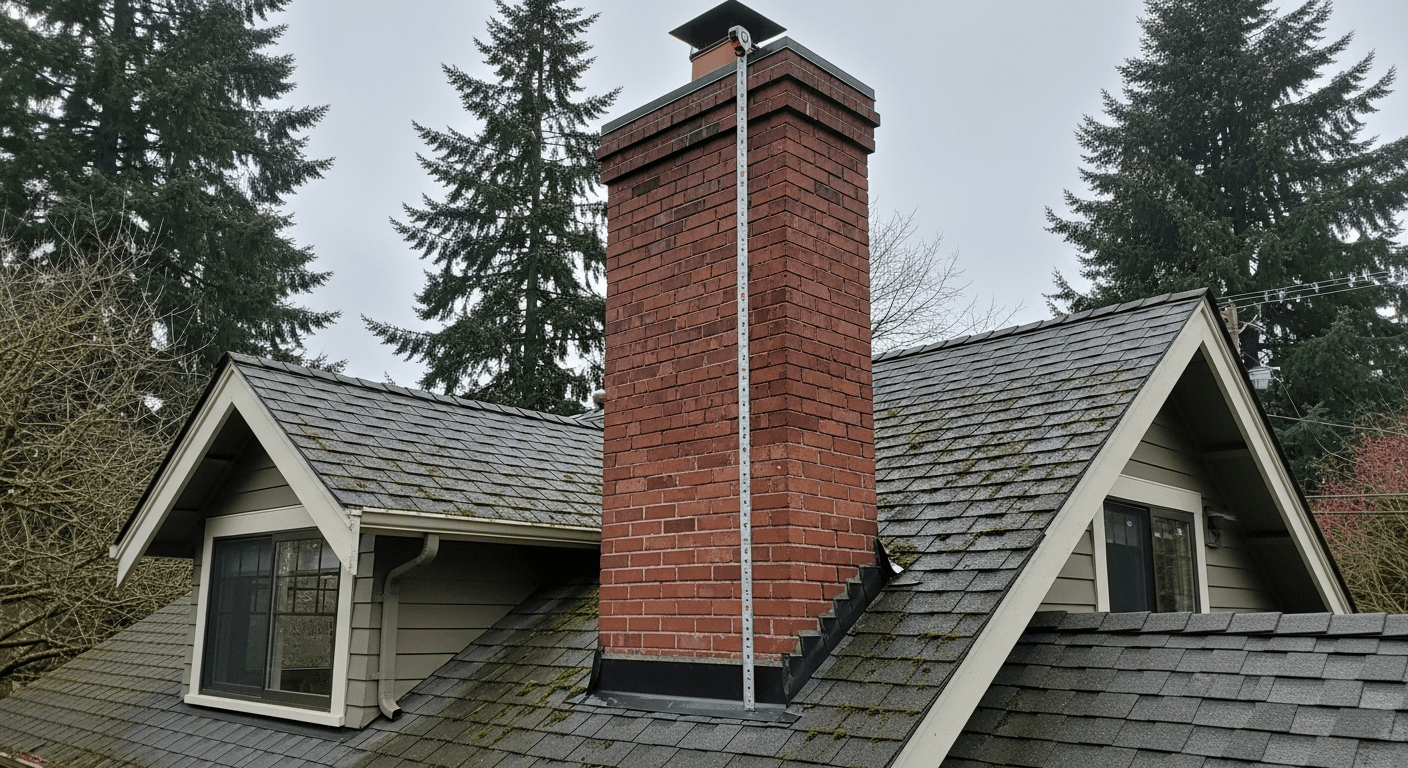
For a more calibrated estimate, photograph the chimney from the side of the house with a tape measure or a ladder of known height in the frame. Using the known object as a scale reference, you can estimate height differentials to within a few inches — not a professional measurement, but enough to distinguish a 6-inch gap from a 6-foot one.
The definitive answer requires a Level 1 or Level 2 inspection by a certified chimney technician, who will measure actual chimney height and horizontal clearances against current IRC requirements and document any deficiencies in writing. If your home is in Houghton, Norkirk, or Moss Bay and has not had a professional inspection since its last re-roof, or if you've added any structure to the home in the past decade, scheduling that inspection now — before the peak Kirkland burning season runs from October through February — is the most cost-effective step you can take.
Frequently asked questions
What is the 2-10-3 rule for chimneys?
The 2-10-3 rule requires a chimney to extend at least 3 feet above the roof surface at the point it exits the roof, AND at least 2 feet above any roof structure within 10 horizontal feet. Both conditions must be met simultaneously on a Kirkland home; whichever demands more height controls. The rule is codified in NFPA 211 and the International Residential Code adopted by Kirkland.
Will homeowners insurance cover a claim if my chimney doesn't meet the height rule?
Policies typically cover sudden events like storm damage, but if a post-incident investigation finds a Kirkland chimney was out of IRC compliance before the event, many insurers treat that as a pre-existing code violation and use it to reduce or deny the claim. Correcting a height deficiency proactively removes that exposure.
Does re-roofing a Kirkland home affect chimney height compliance?
Yes. Adding new sheathing over existing decking — common in Kirkland re-roof projects — can raise the effective roof surface by one to two inches. On a chimney that was already close to the minimum 3-foot clearance, that is enough to create a technical violation. Chimney height should always be reassessed after any roofing work on a Kirkland home.
How much does a chimney sweep and inspection cost in Kirkland?
A standard sweep and Level 1 inspection for a wood-burning fireplace in the Kirkland area runs $150–$280. If significant creosote buildup, a Level 2 video inspection, or additional work such as cap replacement is needed, costs in Kirkland typically reach $350–$600. Be cautious of quotes below $120 that do not include a written inspection component.
Can I fix a chimney height problem myself?
No. Extending a masonry or metal flue on a Kirkland rooftop is skilled, fall-hazard work, and structural chimney alterations in Kirkland require a permit and must be performed or directly overseen by a licensed contractor. A wind-directional cap can marginally improve draft but is not a code-compliant substitute for correct height. Any height extension work on a Kirkland chimney should be done by a certified chimney professional who can document the corrected measurements.
Related services