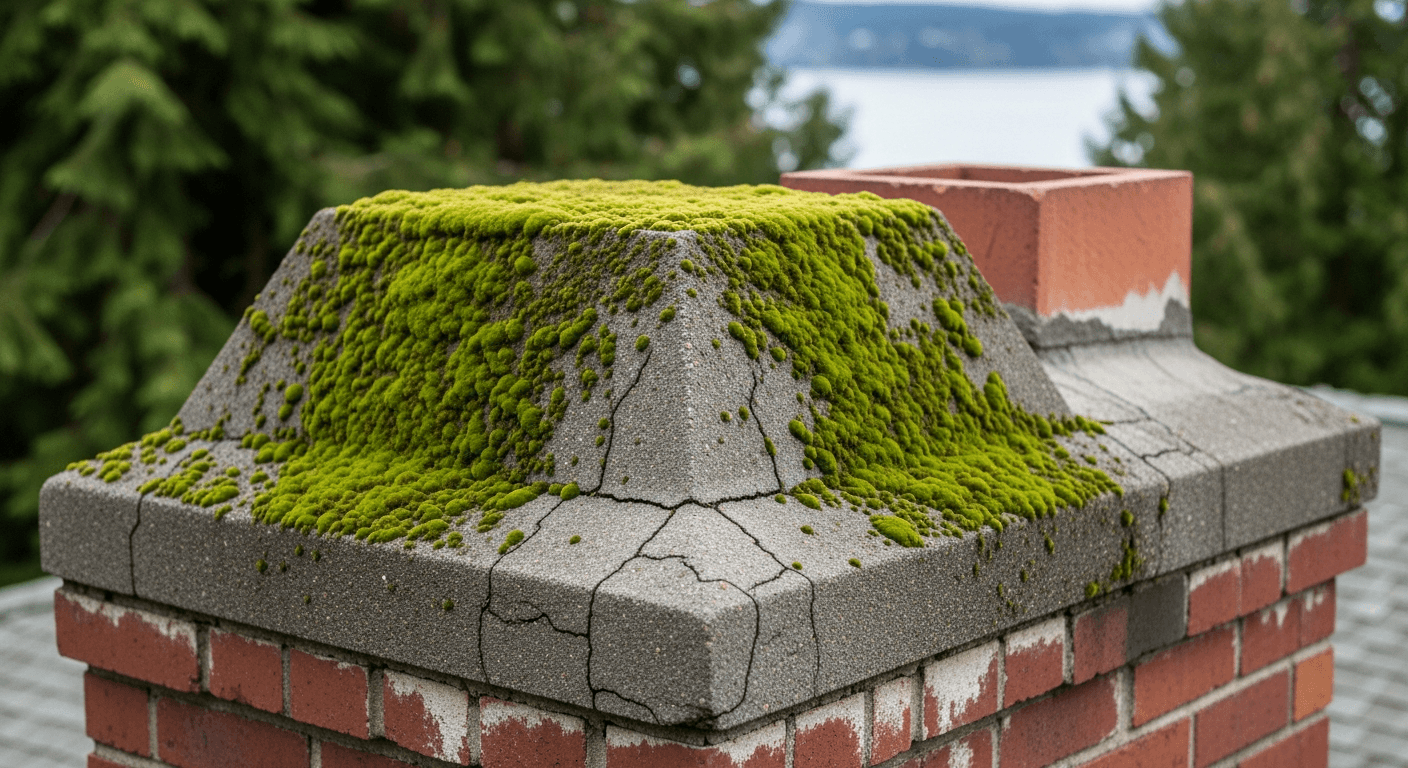
Yes — if you can see cracks in your chimney crown or a green mat of moss spreading across the top, both need attention before October, when Kirkland's rainy season begins and freeze-thaw cycling starts prying those cracks wider. A damaged crown lets water into the masonry beneath it, and moss accelerates that damage by driving root-like rhizoids into existing cracks, so what looks cosmetic in summer becomes a structural repair — and a much larger invoice — within two or three wet winters.
What is a chimney crown and why does Kirkland's climate punish it so hard?
The chimney crown is the sloped concrete cap that covers the full top of your chimney's masonry shell, leaving only the flue liner opening exposed. It is the primary barrier between your masonry and the weather — and in Kirkland, that barrier absorbs roughly 38 inches of precipitation a year, concentrated in relentless drizzle from October through April.
That sustained moisture cycles destructively through the crown: it soaks in during rain, then expands when overnight temperatures drop below freezing. The Eastside regularly logs 15 to 20 freeze-thaw cycles in a single winter season. Each cycle levers hairline cracks a fraction wider. Many Kirkland homes built between 1970 and 1990 have crowns mixed from basic mortar rather than the purpose-formulated concrete required today, making them especially vulnerable to spalling by the time they reach their third or fourth decade.
Geometry matters too. A properly built crown extends at least 2.5 inches beyond the chimney face on all sides, creating a drip edge that throws water clear of the brick. Crowns without that overhang — common on older Kirkland construction — allow runoff to sheet directly down the masonry, staining the brick and accelerating both crown erosion and mortar joint failure in the courses below.
Why does moss grow on Kirkland chimneys and what damage does it actually cause?
Moss thrives in exactly what Kirkland delivers: persistent shade, high ambient humidity, and a rough, porous surface to colonize. Chimneys facing north or sitting under Douglas fir or western red cedar canopy — both abundant throughout the Juanita, Bridle Trails, and Norkirk neighborhoods — can develop a visible moss layer within two to three years of construction or after the last professional cleaning.
The damage is structural, not just cosmetic. Moss and lichen hold moisture against the crown surface like a saturated sponge, roughly doubling the time the concrete stays wet after each rain event. More critically, moss rhizoids — the thread-like root structures — penetrate existing hairline cracks and physically widen them season by season. A crack measuring 1/16 inch in spring can reach 1/4 inch by the following fall once rhizoids have worked through it across a full wet season.
Left untreated for two or more seasons, moss migrates from the crown down the brick face, making repairs more extensive and expensive. In our experience inspecting Kirkland rooftops, homes within a quarter mile of Lake Washington or under dense tree canopy tend to reach heavy moss colonization in as little as 18 months after the last treatment — faster than many homeowners expect.
How do you know whether your crown needs patching, resurfacing, or full replacement?
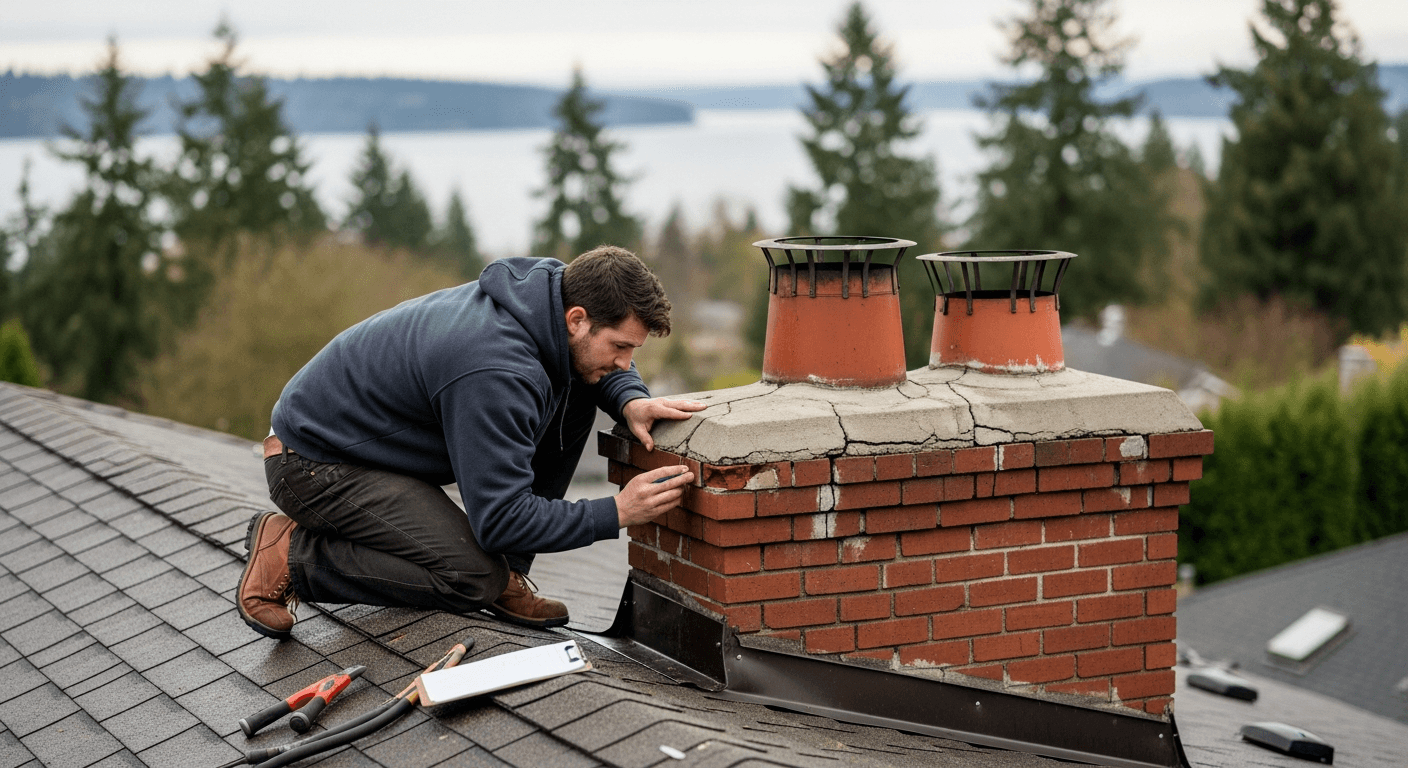
A ground-level scan with binoculars can flag obvious warning signs: white efflorescence streaking down the brick face, visible moss or lichen across the crown surface, chunks of concrete missing from the crown edges, or mortar that appears darker and sunken at the crown perimeter. But an accurate diagnosis requires a technician on the roof.
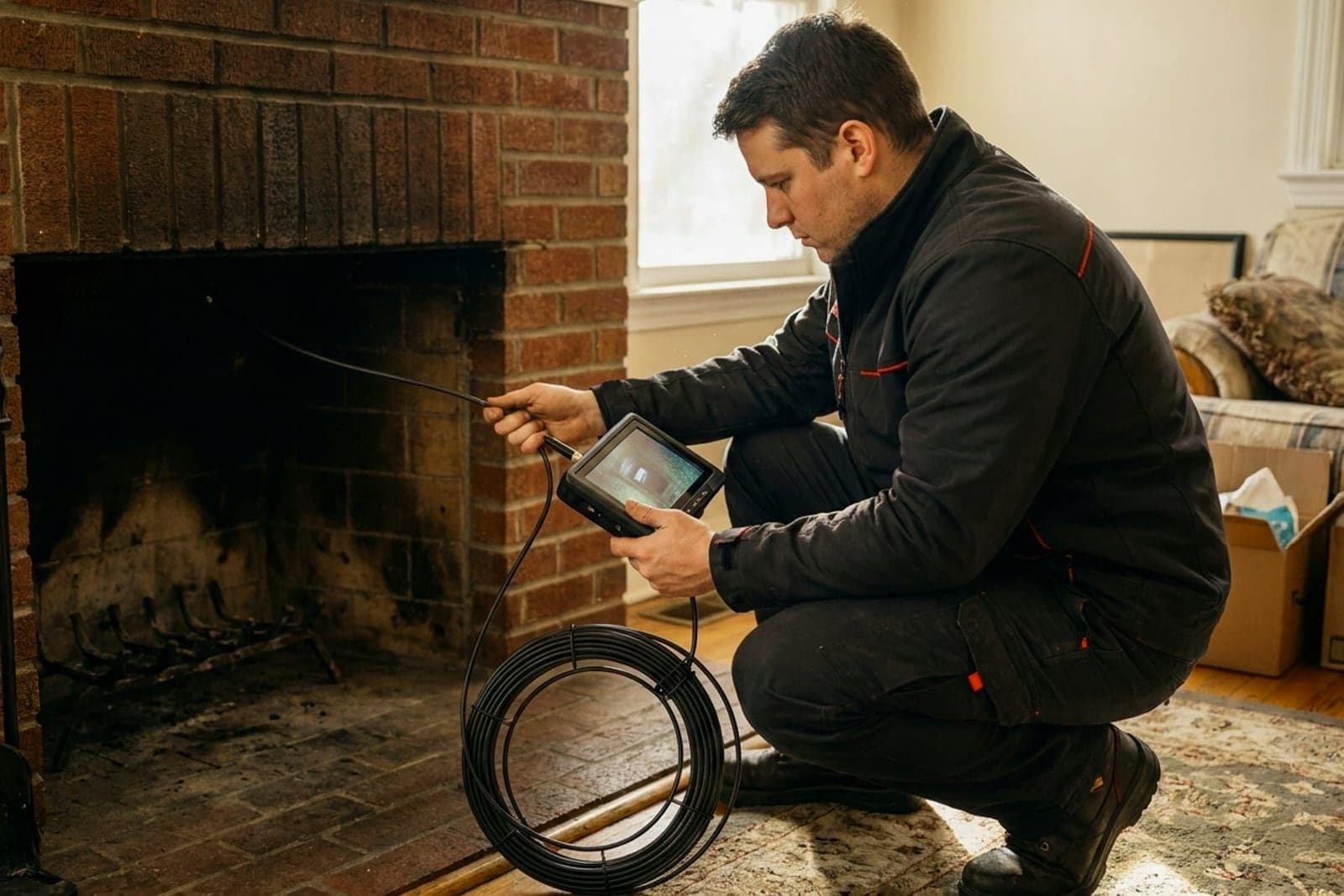
During a Level 1 or Level 2 chimney inspection, the technician probes the crown with a pick or screwdriver: sound concrete resists with a sharp tap; deteriorated material crumbles or sounds hollow. That test combined with measuring crack width and depth determines the correct repair tier. Flexible elastomeric crown sealant handles hairline cracks under 1/8 inch with no structural compromise. A purpose-mixed crown resurfacing compound suits moderate cracking and surface erosion where the substrate is still bonded. Full demolition and replacement is required when the crown has separated from the flue collar, cracks exceed 1/4 inch through the full depth, or the original crown was built without a drip edge.
A practical threshold we apply on Kirkland jobs: when more than 30 percent of the crown surface shows active cracking or spalling, the labor to prep for resurfacing exceeds what replacement saves, and a new crown becomes the better long-term value.
| Visible Symptom on a Kirkland Chimney | Most Likely Cause | Urgency Level | Recommended Next Step |
|---|---|---|---|
| White streaks (efflorescence) on brick face below the Kirkland chimney crown | Water infiltrating through crown cracks and leaching salts out of masonry | High — address before next rainy season | Roof-level inspection to assess crack depth and extent |
| Green or dark moss mat on crown surface | Persistent shade and humidity; rhizoids penetrating existing micro-cracks | Moderate-to-high — worsens each wet season | Biocide treatment plus crack assessment |
| Hairline cracks under 1/8 inch across crown surface | Normal freeze-thaw cycling over multiple Kirkland winters | Moderate — seal promptly to prevent widening | Elastomeric crown sealant application |
| Cracks 1/8–1/4 inch wide, surface spalling or erosion present | Advanced freeze-thaw damage; possible original mortar-mix crown | High — resurfacing needed before fall rains | Crown resurfacing with purpose-mixed compound |
| Cracks exceeding 1/4 inch or crown separated from flue collar | Structural failure; original crown lacked drip edge or proper mix | Critical — active water infiltration likely | Full crown replacement |
| Musty odor indoors after rain, no plumbing cause found | Water tracking down flue wall from deteriorated Kirkland chimney crown | Critical — masonry saturation may already be occurring | Level 2 chimney inspection including roof-level crown assessment |
| Soft or sunken mortar joints in top brick courses | Prolonged water infiltration from failed crown allowing saturation of upper masonry | High — tuckpointing needed alongside crown repair | Crown repair or replacement bundled with tuckpointing |
What does chimney crown repair and moss removal cost in Kirkland?
Costs depend on chimney height, roof pitch, damage severity, and whether moss removal is bundled with crown work. The table below reflects current ranges for Kirkland-area single-family homes. Prices assume standard one- or two-story access; steeply pitched roofs or chimneys requiring extended ladder setups may add a mobilization fee of $75 to $150.
Bundling moss treatment with crown repair is almost always the right call. Biocide application after repair prevents re-colonization and protects the freshly cured crown surface. Applying biocide alone — without addressing underlying cracks — kills visible moss but leaves the moisture-retention problem intact, so the moss returns within one to two seasons.
Elastomeric crown coatings carry manufacturer warranties of 10 to 15 years when applied to a properly prepared surface. Full replacement crowns poured with quality concrete and a formed drip edge should last 20 to 30 years under Kirkland conditions.
| Service | Typical Cost Range | Expected Lifespan | Best Candidate |
|---|---|---|---|
| Moss removal + biocide treatment only | $150 – $275 | 2–4 years before re-treatment | Crown structurally sound, no significant cracks |
| Crown sealant / elastomeric coating | $250 – $450 | 10–15 years | Hairline cracks under 1/8", sound substrate throughout |
| Crown resurfacing (new mix applied over existing) | $400 – $700 | 10–20 years | Moderate cracking, surface erosion, no separation from flue |
| Full crown replacement | $700 – $1,400 | 20–30 years | Deep cracks, separation from flue collar, missing drip edge |
| Moss removal bundled with any crown repair | Add $100 – $200 to repair cost | Protects repair surface | Recommended whenever any crown work is scheduled |
| Crown replacement + chimney waterproofing combo | $900 – $1,600 total | 15–20 years combined | Best long-term value on Kirkland masonry built before 1995 |
A Kirkland homeowner scenario: catching the problem before a remodel got expensive
Consider a hypothetical homeowner in the Bridle Trails neighborhood who calls after noticing a persistent damp smell in their living room every time rain moves through. The house was built in 1984 with a wood-burning fireplace that had sat largely unused for several years. They had already had a plumber inspect for pipe leaks and come up empty.
When a technician reaches the roof, the crown makes the cause immediately clear: a dense moss mat covers roughly two-thirds of the surface, and beneath it the concrete has cracked in three places — one crack running nearly the full crown width and measuring close to 3/8 inch at its widest point. Rainwater has been tracking down the interior flue wall and wicking into the surrounding masonry for at least two seasons.
Because the infiltration has gone unchecked that long, the inspection also reveals soft mortar joints in the top three brick courses — tuckpointing that would have been unnecessary with earlier intervention. In this scenario, the homeowner chooses full crown replacement bundled with biocide moss treatment and targeted tuckpointing on the affected courses, with a total coming to just under $2,100 — a fraction of the interior drywall and finish work they would have faced had water reached the firebox surround. The lesson we share with every Kirkland client: the crown is inexpensive to maintain and costly to neglect.
When is the best time of year to repair a Kirkland chimney crown?
Concrete crown mixes and elastomeric coatings both require ambient temperatures above 40°F and a surface dry enough to accept adhesion — conditions that Kirkland reliably provides from late April through September. August and early September are the optimal window: statistically the driest months in the region, temperatures are stable above 60°F, and the repair fully cures before the first sustained rains arrive in October.
When damage is discovered mid-winter — often triggered by a musty odor or interior water staining — a temporary waterproof patch can halt active infiltration until proper repair conditions return in spring. This is not a permanent solution, but it prevents the damage from advancing through another 15 to 20 freeze-thaw cycles while you wait for curable weather.
Moss treatment is a separate timeline: biocide can be applied year-round as long as the crown surface is not frozen, because the product works on contact and does not require a curing window. A practical Kirkland maintenance schedule: biocide application in October to suppress winter moss growth, followed by crown repair or replacement the following August when conditions support a full, long-lasting cure. If the fireplace is idle during Puget Sound Clean Air Agency burn-ban periods, that downtime is also a natural opportunity to schedule a full chimney-top inspection without disrupting your heating routine.
Frequently asked questions
Can I just scrub the moss off my Kirkland chimney crown myself?
Scrubbing a Kirkland chimney crown removes visible growth but leaves rhizoids embedded in the concrete; without a biocide application, regrowth appears within one season. Stiff-brush scrubbing also risks widening hairline cracks on an already-stressed crown. Have the surface assessed by a technician at the same time so any underlying cracks are caught before the next rainy season.
How long does chimney crown repair take?
Moss removal and biocide treatment on a Kirkland chimney crown take one to two hours. Crown sealant or elastomeric coating application takes two to four hours including surface prep, with a four-to-six-hour window before the surface is rain-safe. Full crown replacement typically takes half a day on-site, followed by a 24-to-48-hour cure period before rain exposure.
Will homeowner's insurance cover a cracked chimney crown in Washington State?
Washington homeowner policies generally do not cover a cracked chimney crown caused by gradual deterioration. Policies cover sudden damage from named perils — a falling tree branch or a lightning strike, for example — but gradual deterioration from freeze-thaw cycling and moisture infiltration is classified as deferred maintenance and excluded. Keep dated photos and itemized invoices for every chimney repair; they support your position if a claim ever does arise from secondary water damage.
How often should a Kirkland chimney crown be treated for moss?
A quality biocide treatment keeps most Kirkland chimney crowns moss-free for two to four years. Homes under heavy Douglas fir or cedar canopy near Lake Washington typically need re-treatment on the shorter end of that range — every two years. A repaired or new Kirkland crown finished with elastomeric coating extends the interval because the smooth, denser surface gives moss rhizoids less purchase.
Does a gas insert fireplace still need a chimney crown in good condition?
Yes. A gas insert routes combustion products through the existing masonry flue, and a deteriorated Kirkland chimney crown allows water into the liner, the surrounding brick, and eventually the firebox area — independent of what fuel is burned. Water damage to a stainless steel liner insert can void the liner warranty, making crown maintenance an issue of both structure and equipment coverage.
Related services